



When an RIA publishes investment performance, compliance under the SEC Marketing Rule is not a box to check; it directly shapes exam outcomes and regulatory risk. Performance claims surface across websites, emails, social posts, PDFs, and multimedia, and manual review turns that volume into a choke point that slows campaigns and increases the odds of missed disclosures. This guide breaks down the leading performance advertising compliance tools to show which solutions actually identify violations before content goes live and which simply add workflow layers without reducing exposure.
TLDR:
- Performance advertising compliance tools automate the review of investment performance claims, hypothetical returns, and testimonials under SEC Marketing Rule requirements.
- AI-powered systems flag missing disclosures and unsubstantiated claims across web, email, social, and video content before publication.
- Some modern solutions combine AI trained on proprietary compliance datasets with direct access to former CCOs and regulators for detailed performance advertising questions.
- Most tools lack some combination of live website monitoring, multi-language support, or on-demand expert escalation for complex SEC Marketing Rule interpretation.
- Certain tools are AI-powered marketing review platforms that automate compliance checks while providing exam-ready audit trails and faster approval cycles.
What Are Performance Advertising Compliance Tools for RIAs
Performance advertising compliance tools are software systems that review, approve, and monitor marketing content containing investment performance claims. They scan materials for regulated elements like past performance data, hypothetical returns, testimonials, endorsements, and projections that fall under SEC Marketing Rule requirements.
These tools exist because performance advertising carries specific regulatory obligations. The SEC Marketing Rule requires documentation, substantiation, and disclosures around performance claims. Manual review is time-consuming and prone to oversight as firms scale their digital marketing across websites, email campaigns, and social media.
The value is dual: protect your firm from exam findings and fines while accelerating how quickly you can publish compliant content. Instead of bottlenecking every piece of marketing at a single compliance officer's desk, these systems automate initial screening and flag risks so human reviewers focus on judgment calls.
How We Ranked Performance Advertising Compliance Tools
We assessed each tool on criteria that matter when catching violations before they go live.
- AI accuracy: How well does the system detect performance advertising risks like unsubstantiated claims, missing disclosures, or prohibited guarantees? False positives slow teams down. False negatives create regulatory exposure.
- Content coverage: Can the tool review web pages, social posts, email campaigns, PDFs, and video or audio content? Performance claims appear across every channel, so partial coverage creates gaps.
- Workflow depth: Does the system support multi-party approvals, version tracking, and comment threads so marketing and compliance can collaborate without email chains?
- Archiving: Does the tool support SEC investment adviser recordkeeping expectations (and, where applicable, FINRA/SEC 17a-4 recordkeeping for dually registered firms) with tamper-evident storage and audit-ready exports?
- Integrations: Can it plug into your CMS, email tool, or social scheduler without forcing teams to copy-paste into another system?
- Expert access: When the AI flags something ambiguous, can you escalate to a human compliance professional who understands detailed regulatory interpretations?
- Implementation speed: How quickly can you go from contract signature to first reviewed asset?
Luthor
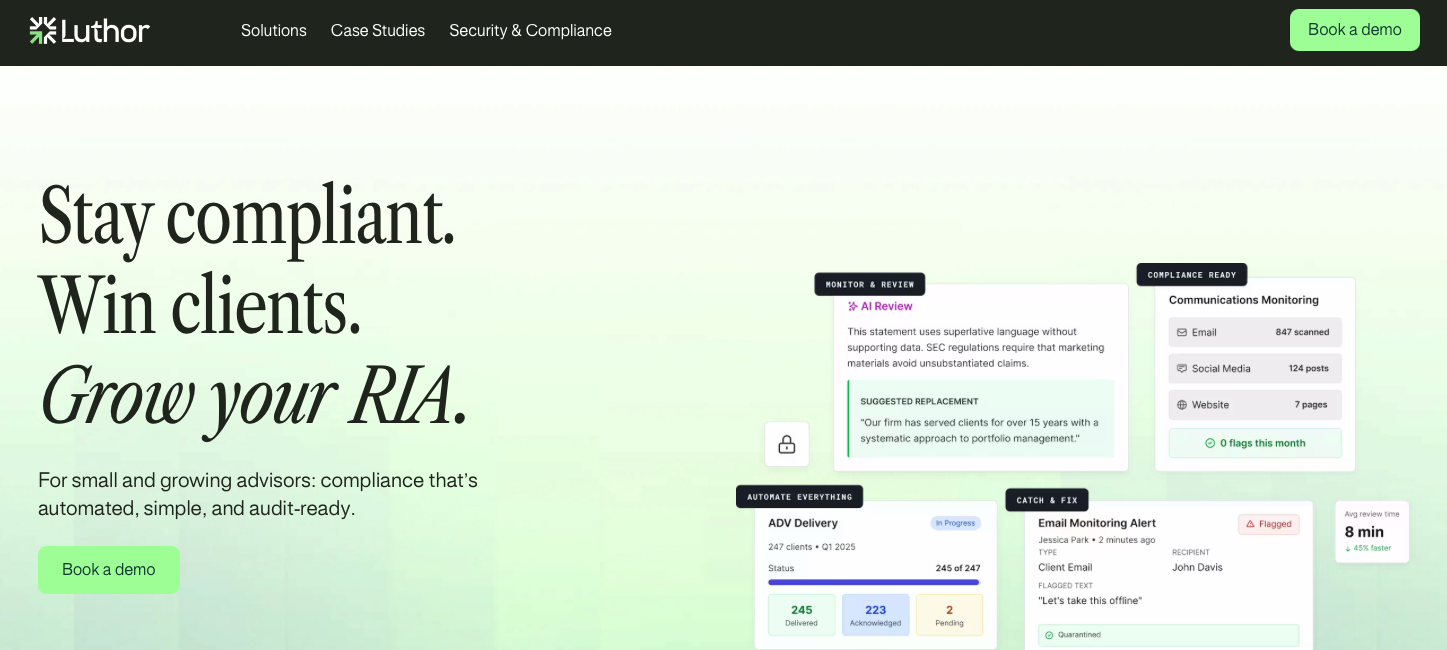
Luthor is an AI-powered marketing review system built for RIAs publishing performance advertising under the SEC Marketing Rule and related federal securities regulations. The system pairs AI models trained by compliance professionals with on-demand access to former regulators and CCOs.
What Luthor Offers
- AI review engine that scans performance claims, hypothetical returns, testimonials, and disclosures across web, email, social, PDF, video, and audio content
- Custom rules engine that encodes firm-specific policies on top of SEC Marketing Rule requirements and, where applicable, FINRA Rule 2210 for dually registered firms
- Real-time monitoring of live websites and adviser pages to detect post-publication edits
- Exam-ready audit trails with tamper-evident archiving that documents every approval, edit, and publication event (and supports WORM formats where required for broker-dealer recordkeeping)
- Expert support from former CCOs and compliance professionals for high-risk campaigns
The system handles routine compliance checks through AI and judgment calls through expert review, removing the need to stitch together separate workflow, archiving, and consulting solutions.
Kadince
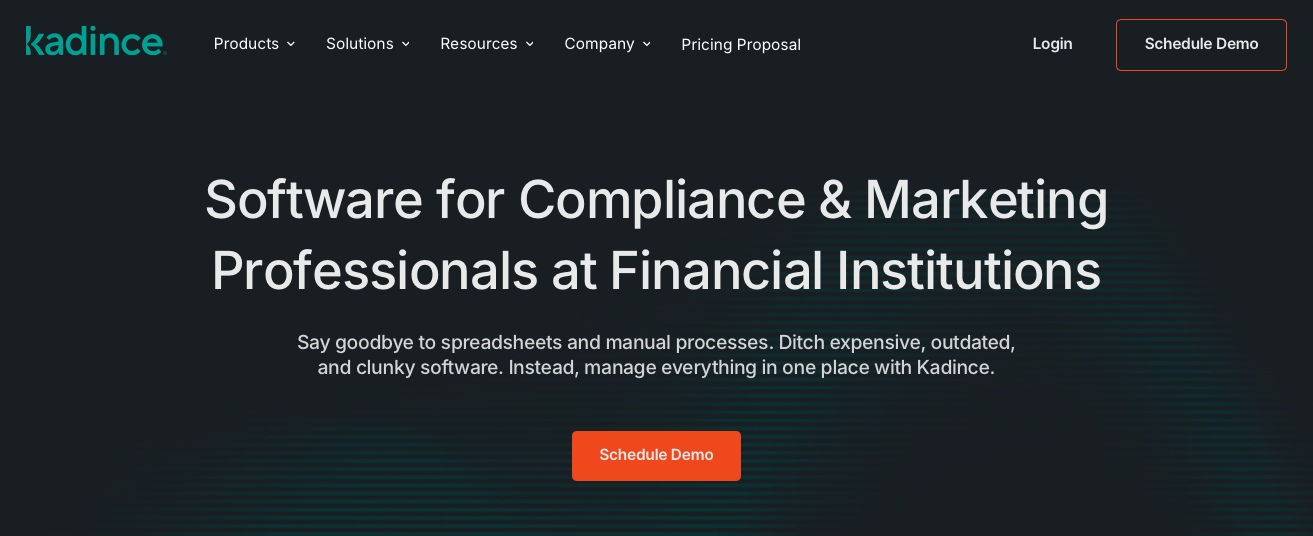
Kadince is workflow and archiving software for banks and credit unions managing marketing compliance and CRA tracking. The system provides project management and approval routing for marketing campaigns with basic compliance workflow.
What They Offer
- Project-based workflow with email notifications and approval routing
- Digital archiving of marketing materials with searchable audit trails
- Compliance review tracking across marketing campaigns
- ROI reporting for marketing initiatives
Good for community banks and credit unions that need a basic workflow system to document marketing approvals and prepare for bank examiner audits.
The limitation is material: Kadince is built for bank and credit union marketing teams, not RIAs. The system lacks native support for SEC Marketing Rule requirements like hypothetical performance checks, extracted performance validation, or testimonial disclosure requirements. It does not include AI-powered content analysis to detect performance claims or missing disclosures.
Kadince works well for banks managing general marketing approvals. RIAs advertising investment performance need tools purpose-built for SEC Marketing Rule complexities.
IntelligenceBank

IntelligenceBank is a digital asset management and marketing operations system with compliance workflow capabilities. The company acquired Red Marker in the mid-2020s to add AI-powered compliance scanning to its existing DAM and workflow features.
What They Offer
- Digital asset management with brand governance and approval workflows that cover version control and audit trails across multiple marketing channels
- AI agents that flag regulatory compliance risks in marketing content, including print, social, email, and web materials
- Marketing project management tools designed for enterprise-scale content operations
The system works well for large enterprises managing digital asset libraries that need centralized brand control with basic compliance review.
The core limitation is that IntelligenceBank was built as a general-purpose marketing operations system, not a specialized financial compliance solution. Its AI models lack the depth required for detailed SEC and FINRA advertising review. The system does not provide access to human compliance experts for performance advertising interpretation. It also lacks exam-specific reporting tailored to SEC workflows.
Saifr

Saifr provides AI-powered risk management solutions that help financial institutions review marketing communications for FINRA and SEC compliance. The company offers SaifrReview for workflow management and SaifrScan as a Microsoft Office add-in to detect compliance risks during content creation.
What They Offer
- AI scanning for FINRA 2210 and SEC Marketing Rule violations across marketing materials
- Risk flagging with suggested alternative language and disclosure recommendations for flagged content
- Video transcription and compliance scanning for social media content to detect performance claims in multimedia
- Microsoft Office add-in for real-time review during document drafting
Saifr works well for large financial services firms with substantial content volumes that need AI-assisted first-pass review to reduce compliance workload.
The limitation is ownership and scale: Saifr is backed by Fidelity-affiliated entities and operates primarily as an enterprise solution. The system lacks human expert support for complex performance advertising questions, does not offer live website monitoring to catch post-publication changes, and pricing is typically geared toward firms with dedicated compliance operations.
Red Oak Compliance

Red Oak provides advertising review software for broker-dealers and investment advisers, with workflow automation and rules-based and automated compliance scanning, including AI-assisted review modules. Founded in 2010, the company serves financial services firms, including broker-dealers that require SEC Rule 17a-4–aligned recordkeeping.
What They Offer
- Advertising review workflow with configurable approval routing
- AI Review module with rules-based content scanning
- Disclosure management and lexicon scanning
- FINRA integration for registration and licensing tracking
Good for existing broker-dealers and large RIAs with complex hierarchical review workflows requiring highly customized approval structures.
The limitation is design philosophy: Red Oak's interface targets legal and compliance teams instead of content creators, which can slow marketing velocity. The system does not offer live website monitoring for post-publication changes, offers limited multi-language content analysis compared to tools built with multilingual AI models, and provides limited integrated expert review for gray areas in performance advertising compliance.
Red Oak works for large institutions with dedicated compliance staff. RIAs that want speed without sacrificing compliance need AI trained on proprietary datasets, real-time monitoring, and direct CCO access in one solution.
Why Luthor Is the Best Performance Advertising Compliance Tool for RIAs
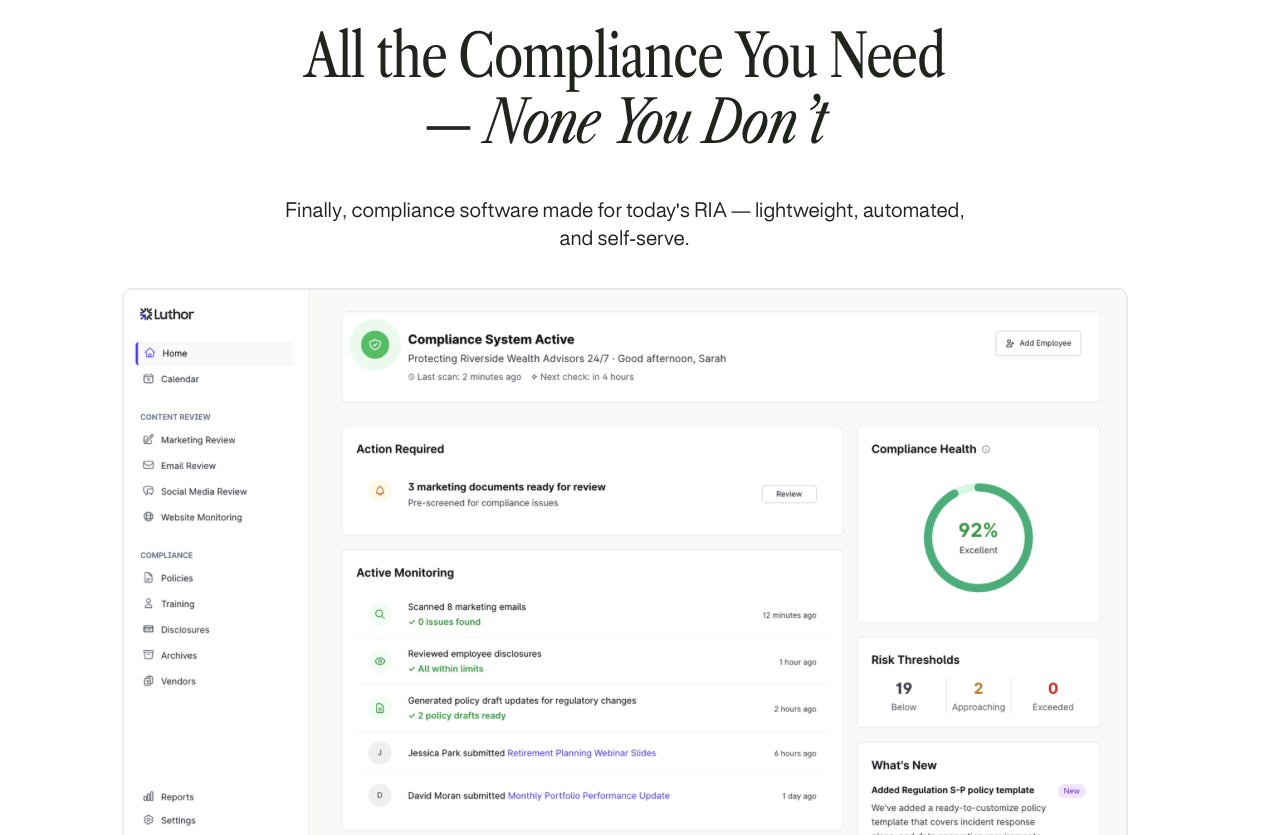
Performance advertising violations attract heightened SEC scrutiny, particularly around hypothetical and extracted performance claims that historically generate exam findings. Most compliance tools lack specialized rule knowledge or provide workflow without intelligence.
Luthor's AI models were trained on proprietary datasets built by compliance experts. That training delivers accuracy on Marketing Rule requirements that define performance advertising risk.
When edge cases arise, you get direct access to former CCOs and regulators who understand how examiners interpret performance claims. The result is faster approvals, cleaner audit trails, and lower regulatory risk.
FAQs
Which performance advertising compliance tool works best for small RIAs without dedicated compliance teams?
Small RIAs benefit most from tools that combine AI automation with expert support. Look for systems that handle routine screening automatically and provide direct access to CCOs for complex questions. Fast implementation (days, not weeks) and transparent pricing matter when you don't have IT resources or budget for lengthy deployments.
What's the difference between AI-powered review and basic workflow tools?
AI-powered tools scan content for specific regulatory violations like unsubstantiated performance claims, missing disclosures, and misleading or impermissible guarantees. Basic workflow tools route materials for human approval but don't detect risks automatically. AI reduces manual review time and catches violations humans miss in high-volume content. Workflow-only systems document approvals but don't prevent violations from reaching reviewers.
When should I consider switching from manual performance advertising review?
Switch when review cycles exceed 48 hours, when you're publishing fewer than 10 marketing pieces per month due to compliance bottlenecks, or when you lack audit-ready documentation for past approvals. If your firm has received exam findings related to performance advertising or if advisers are bypassing review to meet deadlines, you need automated controls and monitoring.
Final thoughts on performance advertising compliance software
If your firm publishes investment performance claims, SEC Marketing Rule performance requirements apply across every channel where that content lives, from websites and social posts to email, PDFs, and video. The right performance advertising compliance software identifies risky performance language before publication, records every approval step, and gives your team a clear path to expert guidance when rules require interpretation. With Luthor, RIAs can move faster without cutting corners, giving marketing teams shorter review cycles, compliance teams clearer oversight, and leadership confidence that performance advertising is built to stand up during exams while supporting growth.