Guides
Best Multi-Channel Compliance Solutions for Wealth Management Firms in December 2025
Compare top multi-channel compliance solutions for wealth management firms in December 2025. AI-powered review, real-time monitoring, and SEC/FINRA archiving.
Luthor Team··Updated ·7 min read
Article details
- Written by
- Luthor Team
- Topic
- Guides
- Published
- Dec 13, 2025
- Last updated
- May 13, 2026
- Reviewed by
- Luthor Team
Reviewed May 13, 2026 for source quality, practical relevance, and regulated-marketing context.
Reviewing adviser content today means supervising websites, email, social media, video, and every other channel where firms communicate with clients, all while meeting SEC and FINRA advertising and recordkeeping rules. Compliance teams must check performance claims, confirm disclosures, and retain exam-ready records as advisers publish across tools that were never designed for controlled financial marketing. The result is growing risk, slow approvals, and supervision gaps that are hard to detect after content goes live. This guide compares multi-channel compliance solutions that centralize review, monitoring, and archiving under one system, including modern marketing compliance software built especially for wealth management firms.
TLDR:
- Multi-channel compliance centralizes review of websites, email, social media, and adviser content under one system to prevent supervision gaps.
- AI-powered solutions flag SEC Marketing Rule violations before publication and monitor live content for compliance drift.
- Some modern compliance tools combine AI trained on SEC and FINRA rules with expert review support to handle higher content volumes while maintaining exam-ready archives.
- Capabilities vary by vendor: certain solutions offer real-time monitoring and video or audio analysis, while others focus only on workflow management or archiving.
- Some tools are best suited for small to mid-sized RIAs that need faster approvals without expanding compliance staff.
What Multi-Channel Review Looks Like Under One System
Most wealth management firms still bolt together separate tools per channel — one for website review, another for social, a third for email, an archive vendor for everything. Each tool has its own rules engine, its own approval queue, and its own gaps. The supervision problem is structural: there's no single place where every channel meets the same standard.
A modern multi-channel compliance solution collapses that into one pipeline:
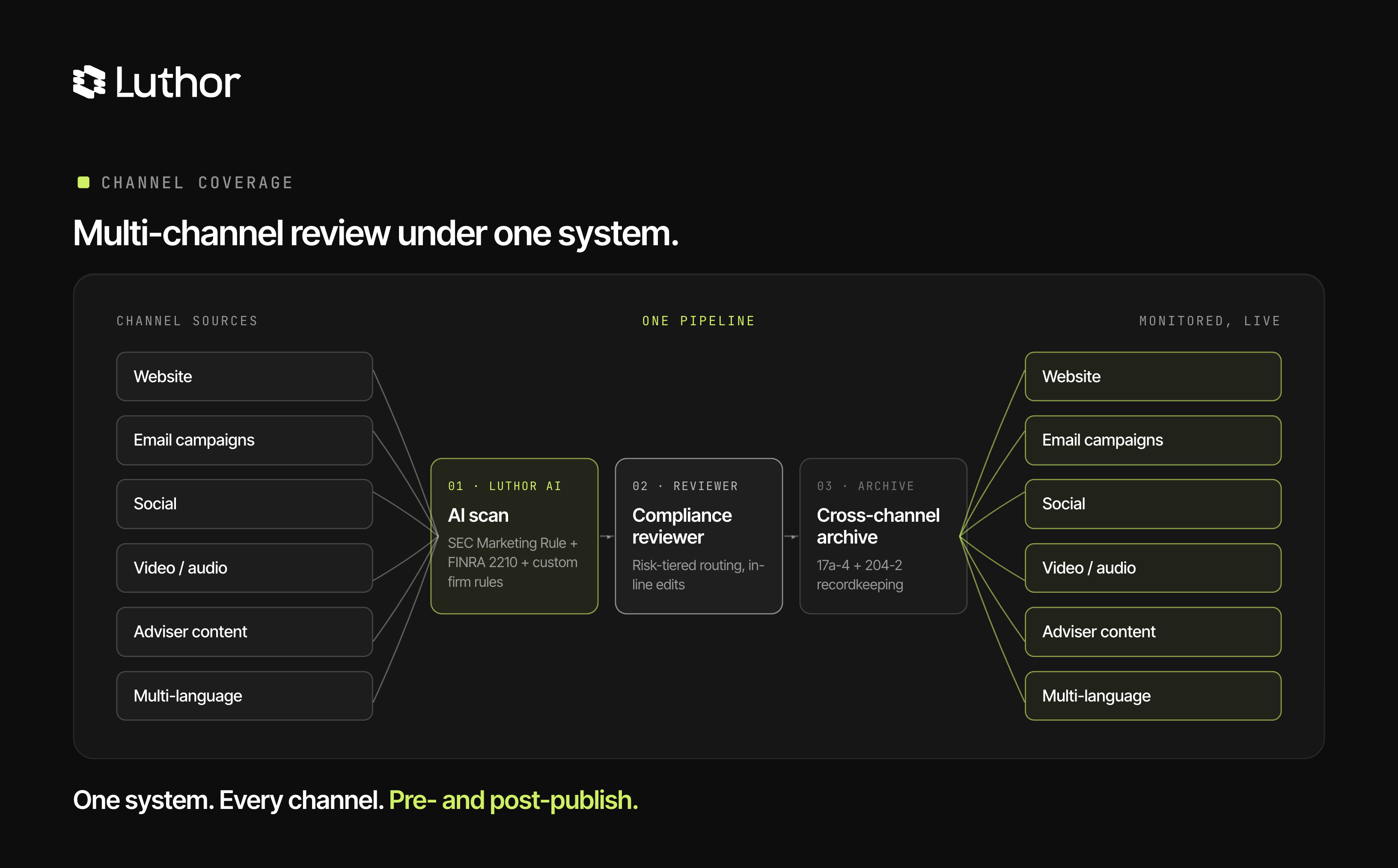
The point of the shape: every channel an adviser publishes to flows into the same review queue, hits the same rules engine, gets archived to the same exam-ready repository, and stays under continuous monitoring once it's live. There are no channel-specific gaps because there are no channel-specific tools.
What Multi-Channel Compliance Actually Delivers for Wealth Management
When a single system covers every channel both before and after publish, the operational picture changes:
- Channel coverage: website-only or social-only review → website, email, social, video, audio, adviser-created content, and multi-language assets all under one queue
- Review cycle time: weeks across fragmented tools → hours through a unified AI pre-screen + risk-tiered reviewer routing
- Marketing output: ~6 pieces/month under manual cross-channel review → 45+ pieces/month on a hybrid AI workflow at the same compliance headcount
- Post-publish supervision: periodic manual sweeps of adviser pages → continuous monitoring across every published surface, with drift auto-routed back to review
- Recordkeeping coverage: archive vendor handles email, gaps everywhere else → unified 17a-4 + 204-2 records on every artifact, every channel, every version
For firms operating in the SEC's 2024 enforcement reality — 583 actions, $8.2 billion in penalties — the gap between "we have an archive" and "we have continuous supervision across every channel" is the gap regulators are now examining.
What Is Multi-Channel Compliance for Wealth Management Firms?
Multi-channel compliance covers the review, monitoring, and archiving of marketing communications across every channel advisers use. Websites, email campaigns, social media posts, landing pages, newsletters, and video content all fall under this scope. Each piece of client-facing content must meet the applicable advertising rules, such as the SEC Marketing Rule for RIAs and FINRA Rule 2210 for FINRA-member broker-dealers and dual registrants.
Wealth management firms face a supervision problem when advisers operate across disconnected channels. An adviser might publish a compliant webpage, then share a LinkedIn post with different performance claims or missing disclosures. Without centralized oversight, firms create gaps in supervision and recordkeeping.
Multi-channel compliance solutions centralize review workflows so the same rules apply everywhere. These systems flag prohibited language, verify required disclosures, and archive every version of every asset. That documentation satisfies recordkeeping obligations under the Investment Advisers Act and Securities Exchange Act.
The right solution also accelerates approvals. Automating repetitive checks and routing only detailed questions to compliance staff lets firms review more content in less time without increasing regulatory risk.
How We Assessed Multi-Channel Compliance Solutions
We assessed each solution against requirements that matter for compliance and marketing teams at wealth management firms.
Channel coverage came first. The solution must review websites, email campaigns, social media posts, and adviser communications from one system. Fragmented tools create supervision gaps.
AI and automation capabilities matter. Pre-review scanning that flags performance claims, testimonials, guarantees, and missing disclosures catches issues before human review. Workflow features for approval routing and collaboration help when teams work across different systems.
Archiving and recordkeeping under SEC Rule 17a-4 and Rule 204-2 is required. The system must maintain audit-ready records of submissions, approvals, edits, and publication events.
Real-time monitoring of published content, integration with existing marketing tools, and reporting features that document evidence for exams separate audit-ready firms from the rest.
Luthor
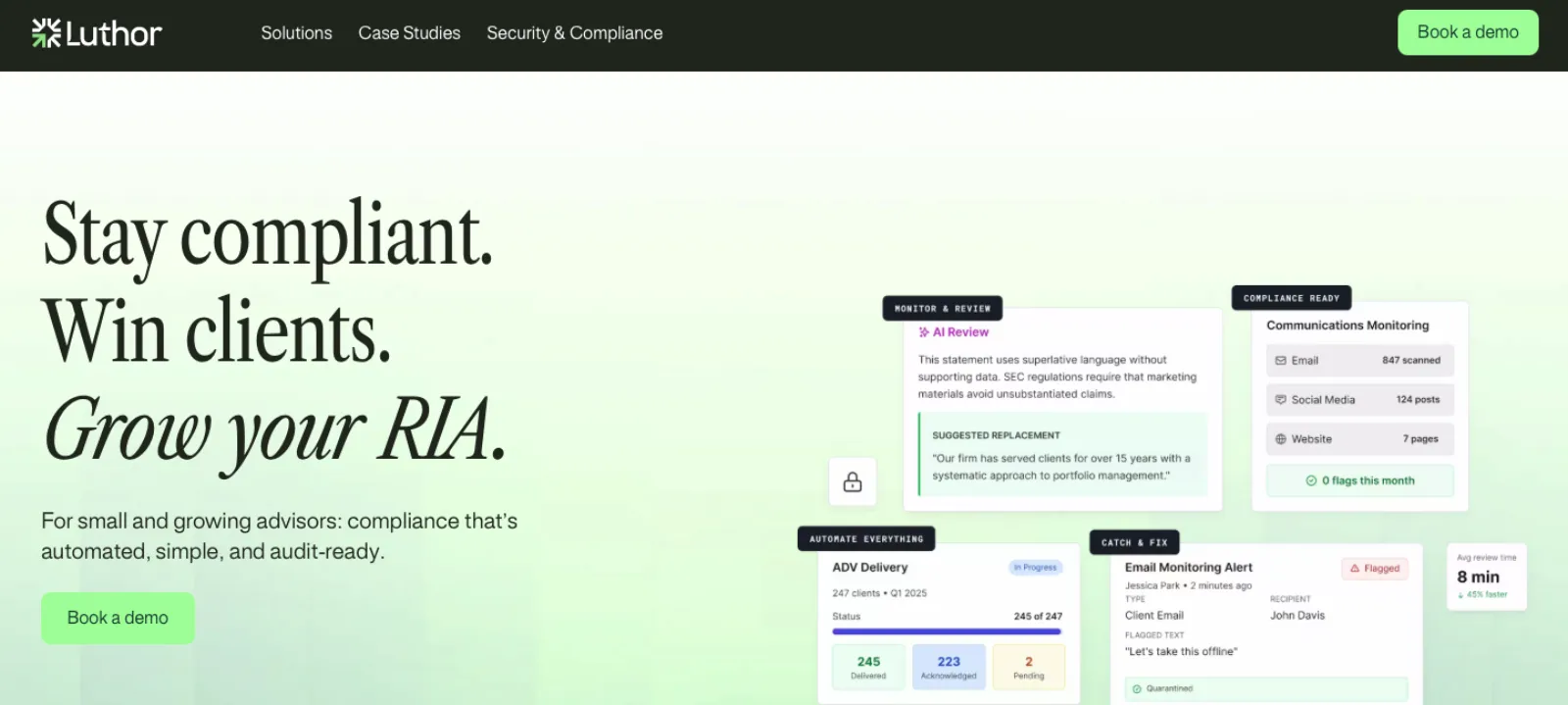
Luthor is an AI-powered marketing review solution built for wealth management firms that need to approve and monitor content across websites, email, social media, and adviser communications. We combine proprietary AI models trained by compliance professionals with expert oversight to catch issues before publication and continuously monitor live content.
What Luthor Offers
- AI review engine that scans for SEC Marketing Rule and FINRA Rule 2210 violations including performance claims, testimonials, guarantees, and missing disclosures
- Real-time monitoring across websites, adviser pages, social feeds, and email campaigns with automatic flagging of unapproved changes
- Multi-channel coverage including video, audio, and multi-language content analysis
- Custom rules engine that encodes firm-specific policies alongside regulatory requirements
- Instant risk alerts with suggested fixes and alternative wording
- Exam-ready compliance dashboard with simplified reporting and audit trails designed to support SEC recordkeeping requirements
- Dedicated compliance expert support for high-risk campaigns and detailed interpretations
Good for: Small to mid-sized RIAs, broker-dealers, and wealth management firms that produce frequent marketing content but lack large compliance teams.
Bottom line: Luthor delivers multi-channel compliance by combining AI accuracy, broader channel coverage, and faster review cycles while maintaining exam-ready documentation.
Works across the channels and tools wealth management firms already use
The "multi-channel" claim only matters if the system actually meets advisers where they publish. Luthor connects to:
- Adviser communications: Microsoft 365 (Outlook, Teams), Google Workspace, Slack
- CRM and adviser platforms: Salesforce, Wealthbox, Redtail
- Archive and retention: Smarsh, Global Relay, and other SEC 17a-4 / 204-2 compliant archives
- Social and video: LinkedIn, Meta business tools, Hootsuite, native social APIs, video platforms for adviser webinars and short-form content
- Marketing and CMS: HubSpot, Mailchimp, Marketo, WordPress, Webflow, and custom adviser-page CMSes
- Multi-language: Spanish, Mandarin, and other languages reviewed against the same rules engine — no separate workflow needed
Compliance reviewers get notifications in the inboxes they already check. Archive obligations route into the system examiners already accept. Post-publish monitoring covers every surface advisers actually use.
Which Team Owns This Decision?
Multi-channel compliance buying decisions usually involve three stakeholders inside a wealth management firm. The right entry point depends on whose pain you're solving for:
- For CCOs and compliance teams — closing the supervision gap across every adviser channel, exam-ready 17a-4 + 204-2 records on every artifact, and continuous monitoring that catches drift before regulators do. See the compliance team view →
- For marketing leaders — replacing the fragmented per-channel review process with one queue, hours-not-weeks cycle times, and adviser content that goes out the door faster without adding compliance friction. See the marketing leader view →
- For RIAs and wealth management firms — supervision built for distributed adviser networks, with the channel breadth and headcount math that lets growth happen without expanding the compliance team proportionally. See the financial services view →
Kadince

Kadince is a workflow and archiving tool built for banks and credit unions that manages marketing project approvals and organizes advertising materials for compliance audits. The solution digitizes approval processes by routing marketing projects through sequential reviewers and storing final assets in a searchable archive.
What They Offer
- Project-based approval workflow with automated notifications to assigned reviewers
- Digital archive of marketing materials organized by project with searchable metadata
- Audit trail documentation showing approval sequence and timestamps
Good for: Community banks and credit unions with straightforward marketing approval processes that need to organize and document existing workflows.
Limitation: Lacks AI-powered content scanning to automatically detect regulatory violations before materials reach human reviewers. Compliance teams must manually identify performance claims, testimonials, and disclosure gaps.
IntelligenceBank

IntelligenceBank is a digital asset management and brand portal solution that helps enterprise marketing teams organize creative assets, manage brand guidelines, and route content through approval workflows. The system includes customizable workflows, audit trails, and AI scanning for brand and legal review.
What They Offer
- Digital asset management system for storing and organizing marketing materials
- Customizable approval workflows with version control and metadata tagging
- Brand portal for distributing approved assets to teams and agencies
- AI content compliance scanning for disclaimers and trigger words
Good for: Large enterprises with complex brand management needs across multiple business units that require centralized asset libraries and standardized brand guidelines in addition to basic compliance checks.
Limitation: Built as a general marketing operations system instead of purpose-built for financial services compliance. It is not purpose-built exclusively for SEC and FINRA-regulated wealth management firms and typically requires additional configuration or external expertise to meet financial-services-specific compliance needs.
Saifr

Saifr is an AI compliance tool from Fidelity Labs that scans marketing content for regulatory violations and routes flagged items through a workflow dashboard. The system analyzes text, images, and video for promissory language, exaggerated claims, and missing disclosures.
What They Offer
- SaifrScan API for analyzing content across text, images, and video formats
- SaifrReview workflow dashboard with risk scoring and inline collaboration
- Real-time scanning during document creation
- Integration with content management and social media tools
Good for: Large broker-dealers and asset managers with high content volumes that need API-based scanning and have technical resources for implementation.
Limitation: Requires enterprise subscriptions with pricing that scales by firm size, making it cost-prohibitive for small to mid-sized RIAs. Primarily focuses on pre-publication risk detection and workflow, with post-publication monitoring and long-term archiving typically handled through external systems.
Red Oak Compliance

Red Oak Compliance is an advertising review workflow system built by former compliance practitioners for broker-dealers, asset managers, and investment advisers. The system focuses on approval routing, disclosure management, and regulatory recordkeeping for firms with complex supervision structures.
What They Offer
- Configurable advertising review workflows with multi-level approval paths
- Centralized disclosure library for standardized language across marketing materials
- SEC Rule 17a-4 and Rule 204-2 compliant archiving with audit trails
- Version control with timestamps and reviewer history
- Support for a wide range of advertising types, including print, digital, and adviser-created materials
Good for: Large broker-dealers and global asset managers with complex multi-level approval hierarchies that need highly configurable workflow engines and can dedicate implementation resources to customize the system.
Limitation: Does not place emphasis on AI-driven, automated pre-review scanning for marketing risk detection in the same way as newer AI-first platforms.
Why Luthor Is the Best Multi-Channel Compliance Solution for Wealth Management Firms
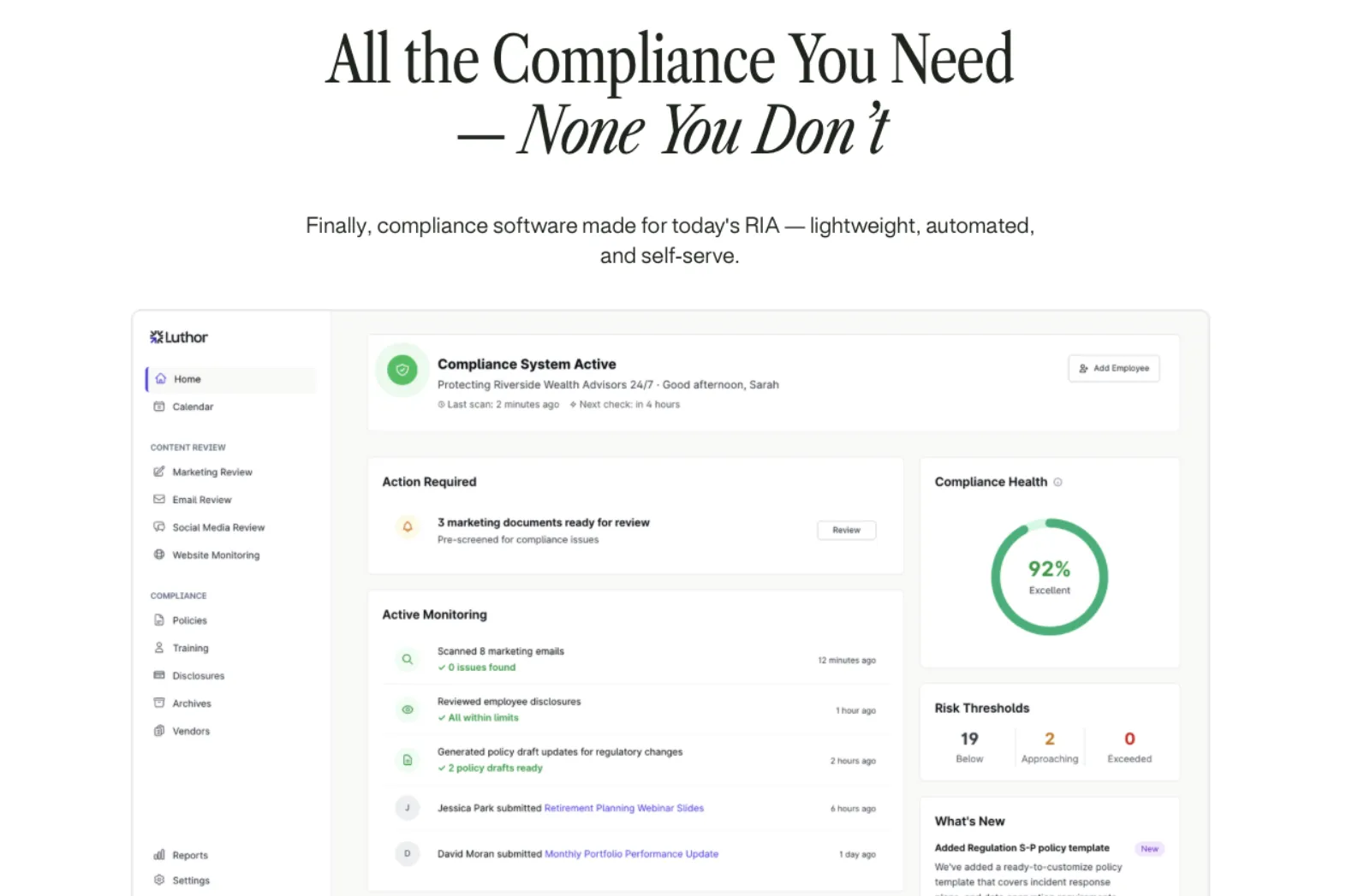
Luthor was built for wealth management compliance from the ground up. Our AI models train on proprietary datasets created by compliance professionals who encoded regulatory nuance into the system. This approach is designed to reduce false positives and improve relevance compared to generic marketing tools not built for financial services.
Continuous post-publication monitoring sets us apart. We scan live websites, adviser pages, and social feeds for compliance drift after content publishes. The SEC brought 583 enforcement actions in 2024 and charged firms $8.2 billion in penalties. Real-time monitoring catches violations before regulators do.
Our system covers channels competitors overlook, including video, audio, and multi-language content. Social media compliance requires ongoing supervision. Advisers need oversight across every channel they use.
The hybrid model pairs AI automation with dedicated compliance expert support. You get enterprise-grade compliance without enterprise pricing or headcount.
FAQs
Can a compliance solution monitor content after it's already published?
Yes, but most solutions only archive content at publication without ongoing monitoring. Real-time monitoring scans live websites, adviser pages, and social feeds for compliance drift after content goes live, catching unapproved edits or new violations before regulators find them. This capability is critical because advisers often update content without routing changes back through compliance review.
What's the difference between AI content scanning and manual compliance review?
AI scanning automatically flags performance claims, testimonials, guarantees, and missing disclosures based on SEC and FINRA rules before materials reach human reviewers. Manual review requires compliance staff to read every line and identify violations themselves. AI handles high-volume pattern detection while human reviewers focus on detailed judgment calls and edge cases.
How long does it take to implement a multi-channel compliance system?
Implementation time varies by solution complexity and firm size. Cloud-based systems with pre-configured SEC and FINRA rules can be functional within days for basic review workflows. Enterprise solutions requiring custom workflow configuration, API integrations, and multi-level approval hierarchies may take weeks to months depending on technical resources and customization requirements.
Final thoughts on managing compliance across channels
Managing multi-channel compliance across email, social media, websites, and adviser communications becomes harder when each channel lives in a separate tool with its own rules and records. Firms need one system that applies consistent supervision standards everywhere, keeps complete audit trails, and detects risk both before and after content goes live. AI-based scanning reduces review backlogs by catching common violations early, while ongoing monitoring surfaces unapproved edits and compliance drift that manual processes miss. Luthor brings these capabilities together so compliance teams can approve more content, maintain exam-ready documentation, and support adviser growth without adding headcount.
Keep reading
Related resources

Guides
The Meaning of Compliance and an Era of Change for Banks, RIAs, and Fintechs
Learn the meaning of regulatory and corporate compliance and its impact on the operations of banks, RIAs, and fintechs.
15 min

Guides
Guide to the Regulatory Agencies in the U.S. Financial Industry
Discover the 20 major regulatory agencies that rule financial industry & learn how they impact banks, RIAs, and fintechs
18 min

Guides
What Is a Compliance Checklist? And How Can Banks, RIAs, and Fintechs Create One?
Discover what a compliance checklist is and how to create one to streamline AML/KYC and consumer protection.
7 min



Never publish risk again.
Our policy and legal engineers will walk through your content workflows and regulatory obligations, then integrate Luthor in days, not months.