Guides
Top Marketing Approval Workflow Software for Broker-Dealers in 2026
Compare top marketing approval workflow software for broker-dealers in June 2026. AI-powered FINRA Rule 2210 review, influencer supervision, mobile app controls, audit trails, and post-publication monitoring.
Glenn Espinosa··Updated ·9 min read
Article details
- Written by
- Glenn EspinosaCEO & Founder
- Topic
- Guides
- Published
- Dec 29, 2025
- Last updated
- Jun 19, 2026
- Reviewed by
- Luthor Team
Reviewed Jun 19, 2026 for source quality, practical relevance, and regulated-marketing context.
Updated June 19, 2026.
Managing FINRA Rule 2210 approvals across dozens of advisers, fast-moving campaigns, influencer posts, mobile app messages, and multiple publishing channels often leaves compliance teams reacting instead of reviewing with confidence. Email threads lose history, spreadsheets fall apart under volume, and manual checks miss violations that surface later during exams. Broker-dealers increasingly rely on marketing approval workflow software that can review content before publication, track approvals automatically, retain records examiners expect, and monitor live content after it changes.
TLDR:
- Broker-dealers need software that automates FINRA Rule 2210 compliance checks and creates audit trails.
- FINRA's 2026 exam focus makes influencer content, mobile app promotions, non-English review, and AI-created communications especially important workflow requirements.
- AI-powered tools flag violations like missing disclosures, promissory claims, and unbalanced risk language before publication, reducing exam risk.
- Post-publication monitoring catches unapproved edits on live adviser pages and social feeds.
- AI-assisted systems should capture prompts, outputs, reviewer decisions, model versions, and override rationale when AI affects the review record.
- Centralized approval workflows replace email and spreadsheets while maintaining consistent standards across advisers and channels.
What Changed for Broker-Dealer Reviews in 2026?
The 2026 software decision is not just "workflow versus email." FINRA's 2026 Communications with the Public priorities call out supervision gaps around social media influencers, static content posted on a firm's behalf, mobile app promotions, push notifications, risk disclosure, and non-English electronic communications review. The same report also highlights GenAI controls for customer communications and chatbot retention.
That changes what buyers should expect from broker-dealer marketing approval software:
- Influencer and adviser content controls: Static posts, testimonials, endorsements, and distributed adviser content should be captured before use and retained after use.
- Mobile app and notification review: Push notifications, in-app banners, and product prompts need the same fair-and-balanced review logic as emails and web pages.
- Language-aware surveillance: Firms conducting business in more than one language need review sampling and detection that can support those languages.
- GenAI evidence: If AI drafts, edits, screens, or summarizes communications, the firm needs documentation showing how the output was supervised.
- Post-publish drift detection: Once approved content is live, monitoring should catch unapproved changes before they become exam findings.
The FINRA 2210 Approval Workflow, End to End
Before comparing tools, it helps to see what a modern approval workflow actually looks like. Every modern marketing approval workflow software solution for broker-dealers ultimately maps to the same six-stage pipeline — what changes between vendors is which stages are automated, which are manual, and how well the audit trail holds up under exam.
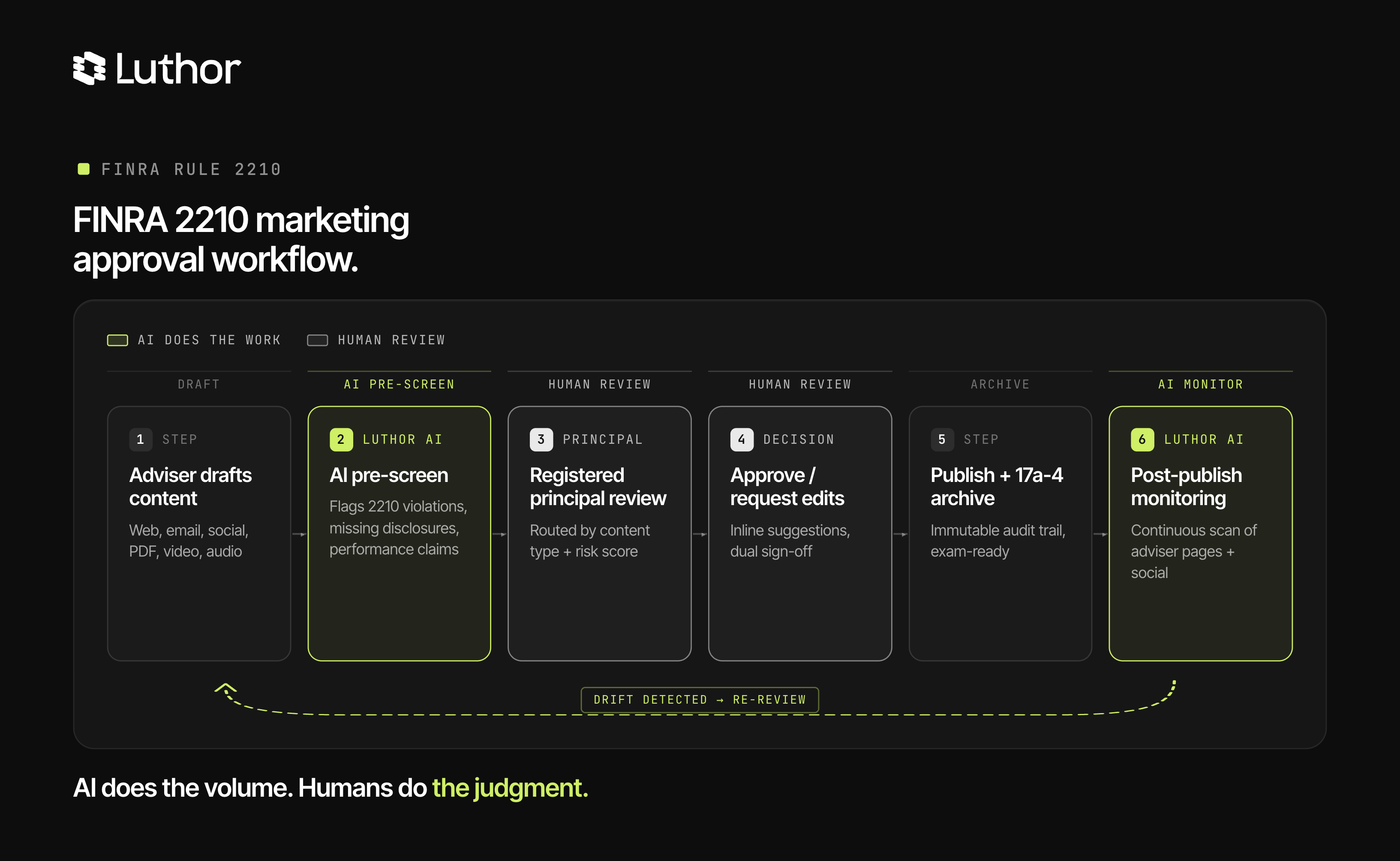
The two stages that swing the most across vendors are the AI pre-screen (stage 2) and post-publish monitoring (stage 6). Tools that automate both let principal reviewers spend their time on judgment calls instead of pattern matching, and they close the supervision gap that opens the moment content leaves the approval queue.
What Modern Approval Workflows Actually Deliver
The operational difference between an email-and-spreadsheet workflow and an AI-assisted one is large enough to show up in headcount math:
- Review cycle time: 1–3 weeks on manual workflows → hours on AI-assisted ones
- Marketing output: 6 pieces/month under manual review → 45+ pieces/month on a hybrid AI workflow at the same compliance headcount
- Adviser-page coverage: periodic manual sweeps → continuous monitoring across every published page and social profile
- Time-to-deployment: months for legacy compliance vault systems → ~2 weeks on modern AI platforms
- Audit-trail completeness: email threads + spreadsheets → immutable 17a-4 records auto-captured on every artifact
The shift isn't incremental. It's the difference between a compliance program that throttles marketing and one that scales with it.
What Is Marketing Approval Workflow Software for Broker-Dealers?
Marketing approval workflow software manages review, approval, and archiving of broker-dealer communications before publication. These systems automate compliance checks against FINRA Rule 2210, which sets standards for broker-dealer communications with the public and requires registered principal approval of most retail communications prior to first use, with supervisory review requirements that vary for institutional communications and correspondence.
The software replaces email chains and spreadsheets. It tracks who reviewed content, when approvals were granted, what changes were requested, and whether required disclosures appear in final versions. Most solutions flag common violations like exaggerated claims, missing risk disclosures, or prohibited performance representations.
FINRA Rule 2210 requires broker-dealers to retain copies of retail and institutional communications, including evidence of principal review and first-use dates, while SEC 17a-4 governs how those records must be preserved using compliant electronic recordkeeping controls. Marketing approval workflow software creates audit trails automatically and stores records in tamper-evident archives.
Manual review processes fail when managing adviser social posts, email campaigns, web pages, and PDF brochures across multiple channels. Firms publishing more than a few marketing pieces monthly need automated workflow software.
How We Assessed Marketing Approval Workflow Software
We assessed each solution against eight criteria:
- FINRA 2210 compliance capabilities: Does the system identify prohibited claims, flag missing disclosures, and enforce principal review requirements for retail communications?
- Workflow automation: Can the software route content to appropriate reviewers, track approval status, and manage revision cycles without manual coordination?
- Audit trail quality: Does it capture every review decision, editor change, and approval timestamp in a format that satisfies FINRA exam requirements?
- Multi-channel coverage: Can it handle web content, email, social media, PDFs, and other asset types through a single review process?
- AI-powered detection: Does it use automation to pre-screen content for common violations before human review?
- Post-publication monitoring: Does it identify unapproved changes after approved content goes live on adviser sites, social feeds, apps, or landing pages?
- GenAI governance evidence: If AI is used in drafting, review, or surveillance, does the workflow retain prompt and output logs, model version information, human approvals, and override rationale?
- Integration capability: Will it connect to existing marketing tools and workflows without requiring teams to abandon current systems?
2026 Buyer Checklist for Broker-Dealers
Before shortlisting vendors, ask each one to show how the system handles a realistic FINRA exam request:
- Can it produce the approved communication, first-use date, reviewer, approval timestamp, source materials, and final published version from one record?
- Can it distinguish retail communications, correspondence, and institutional communications so the correct review standard applies?
- Can it supervise influencer, adviser, and third-party content posted on the firm's behalf?
- Can it review mobile app copy, push notifications, social captions, landing pages, email, PDFs, video, audio, and non-English content in one queue?
- Can it retain AI-assisted review evidence if GenAI generated, modified, summarized, or screened the communication?
- Can it monitor live content after approval and route material changes back to principal review?
- Can it export examiner-ready evidence without reconstructing the workflow from Slack, email, spreadsheets, and archive systems?
Luthor
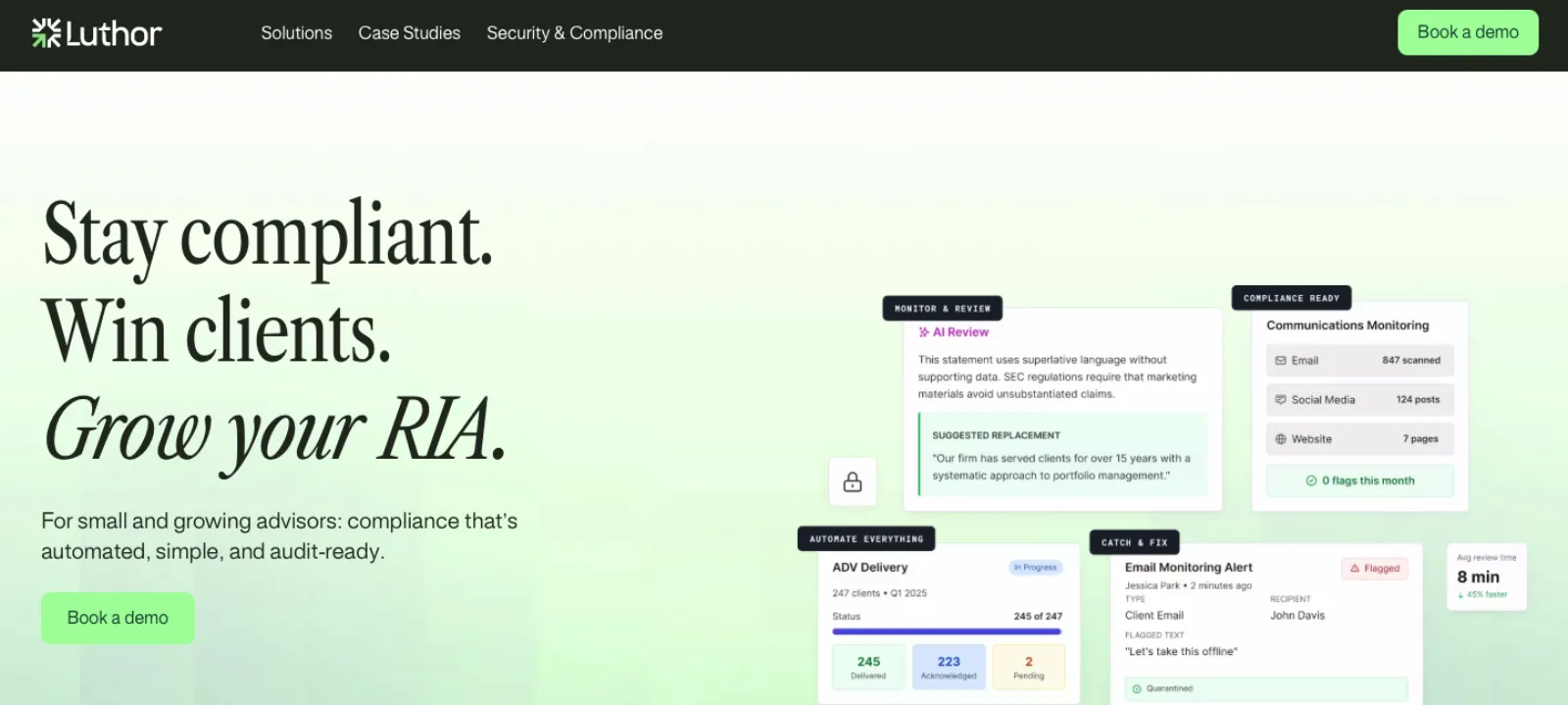
Luthor pairs AI-powered content screening with on-demand compliance experts. The AI review engine flags FINRA 2210 violations across web pages, emails, PDFs, social posts, video, audio, mobile app copy, and adviser-distributed content before materials reach human reviewers. This hybrid approach automates repetitive pattern detection while reserving expert judgment for detailed calls.
The system scans for performance claims, testimonials, guarantees, superlatives, and missing disclosures. When it detects a potential issue, it focuses on the language, explains the underlying rule, and suggests compliant alternatives. Custom rules let you encode firm-specific policies on top of baseline regulatory requirements.
Real-time monitoring tracks live websites, adviser pages, social feeds, and campaign surfaces for unapproved edits after publication. Content that drifts out of compliance automatically routes back through review. All approvals, edits, flags, AI findings, and reviewer decisions are retained in an immutable audit trail designed to support SEC and FINRA examination and record-retention requirements.
The AI models are trained on compliance-reviewed datasets developed with input from experienced compliance professionals. When complex campaigns require deeper analysis, you can escalate directly to former regulators and CCOs who understand exam strategy and edge-case interpretations. For firms using AI in the review workflow, Luthor's operating model aligns with FINRA's 2026 GenAI guidance: AI speeds up analysis, but human reviewers retain approval authority and the system keeps evidence of what was flagged, accepted, revised, or overridden.
Works with the stack your team already uses
Luthor sits in the review layer that has historically been a bottleneck, but it doesn't ask your team to leave the tools they already run on. Common integrations include:
- Collaboration & email: Microsoft 365 (Outlook, Teams), Google Workspace, Slack
- CRM: Salesforce, Wealthbox, Redtail
- Archive & retention: Smarsh, Global Relay, and other SEC 17a-4 compliant archives
- Social & publishing: Hootsuite, LinkedIn, Meta business tools, native social APIs
- Marketing platforms: HubSpot, Mailchimp, Marketo, and major CMS systems
That means principal review notifications land in Outlook or Teams, archive obligations flow into the retention system examiners already accept, and post-publish monitoring covers the social and CMS surfaces advisers actually publish to.
Which Team Are You?
The right marketing approval workflow software depends on who's bearing the operational pain inside the broker-dealer. Three views, three different conversion paths:
- For compliance teams — 17a-4-grade audit trails on every artifact, registered principal sign-off built into the workflow, post-publish drift detection across distributed adviser pages. See the compliance team view →
- For marketing operations — hours-not-weeks approval cycles, in-line edit suggestions instead of redline back-and-forth, integration with the CMS and social stack you already use. See the marketing ops view →
- For broker-dealers and RIAs — scale adviser marketing without adding compliance headcount. Continuous oversight purpose-built for distributed adviser networks. See the financial services view →
Kadince
Kadince is a web-based marketing compliance tool built for banks and credit unions. It includes workflow approval features for financial institutions.
What They Offer
- Browser-based project submission with automated email notifications and approval routing for marketing materials
- Archiving and logging of changes, notes, and approvals with attachment support for tearsheets and ROI tracking
- Automated workflow assignment for spelling, grammar, management, and compliance reviews across multiple file formats
- CRA tracking, community involvement management, and complaint management modules
Kadince works for community banks and credit unions that need basic workflow automation for marketing approvals alongside CRA and community involvement tracking.
The limitation: no AI-powered risk detection or intelligent content analysis for FINRA 2210 or SEC Marketing Rule requirements. The tool relies on manual human review without automated flagging of regulatory violations. This can lead to slower turnaround times and increased compliance risk for broker-dealers managing high volumes of adviser marketing content across multiple channels.
IntelligenceBank
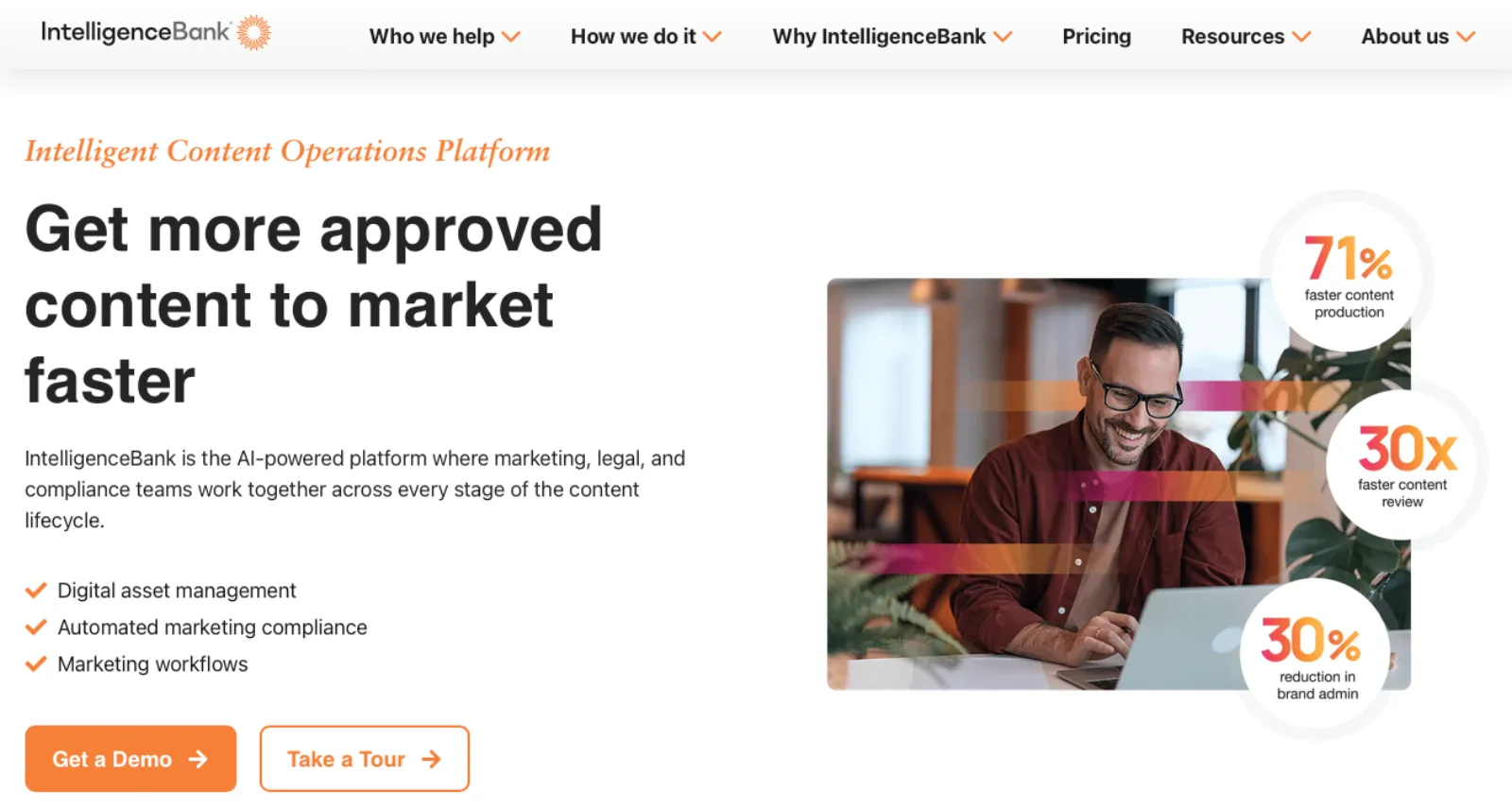
IntelligenceBank is a digital asset management and marketing operations system with brand governance and compliance workflow capabilities built for enterprise marketing teams.
What They Offer
- Digital asset management with version control, metadata tagging, and centralized repository for brand assets and marketing materials
- Customizable workflow approvals with role-based permissions, in-line annotations, and approval tracking for marketing projects
- Marketing compliance module (acquired Red Marker) with AI content review focused on UK and US retail banking regulations
IntelligenceBank works for large enterprises with complex brand management needs across multiple markets that need a DAM and brand portal system where financial compliance is one component among broader marketing operations.
The limitation: IntelligenceBank’s compliance capabilities are generalized across financial services and brand governance use cases, instead of being purpose-built for broker-dealer–specific FINRA Rule 2210 workflows and adviser-level content monitoring. IntelligenceBank is built primarily as a DAM with compliance as an add-on feature. It is not typically deployed as a broker-dealer–purpose-built FINRA 2210 tool for continuous adviser-level monitoring across live sites and social profiles, and capabilities can vary by module and configuration.
Saifr

Saifr is a RegTech solution from Fidelity Labs that uses AI to review financial services marketing communications and monitor electronic communications.
What They Offer
- SaifrReview workflow tool with AI models trained on compliance-reviewed data to flag non-compliant language in written materials, social media, audio, and video
- Risk scoring and disclosure detection during document creation with in-line collaboration between marketing and compliance teams
- SaifrScan for monitoring live websites and published content, with compliance models covering FINRA 2210, SEC 482, and SEC Marketing Rule
- Integration with Microsoft Azure for enterprise deployment
Saifr works for large financial institutions with enterprise tech requirements that already use Microsoft Azure infrastructure and need a vendor with Fidelity pedigree backing the compliance models.
The limitation: while SaifrScan monitors published content, its post-publication surveillance is typically periodic instead of continuous and is not designed for real-time detection of adviser-initiated changes across distributed personal websites and social profiles. Saifr also lacks dedicated CCO expert support, meaning firms interpret complex edge cases without access to former regulators and compliance professionals.
Red Oak

Red Oak is an advertising review and compliance workflow system built for broker-dealers, RIAs, asset managers, and insurance firms with SEC 17a-4 compliant record keeping.
What They Offer
- Advertising review workflow engine with role-based permissions, approval routing, and audit trails for SEC and FINRA compliance
- Disclosure management automation, regulatory reporting, and document archiving compliant with SEC Rule 17a-4 record keeping requirements
- Integration with content distribution tools (acquired 4U) for pre-approved marketing content libraries that advisers can access and share
Red Oak works for broker-dealers with legacy compliance processes that focus on rigid workflow structure and detailed audit trails over user experience and content velocity.
The limitation: built as a document-centric compliance vault with static review rules instead of intelligent AI risk detection. Red Oak lacks automated content analysis, real-time risk scoring, and adaptive learning capabilities. The interface is designed for compliance teams instead of marketers, resulting in low adoption and teams continuing to operate outside the system via email and spreadsheets.
Why Luthor Is the Best Marketing Approval Workflow Software for Broker-Dealers
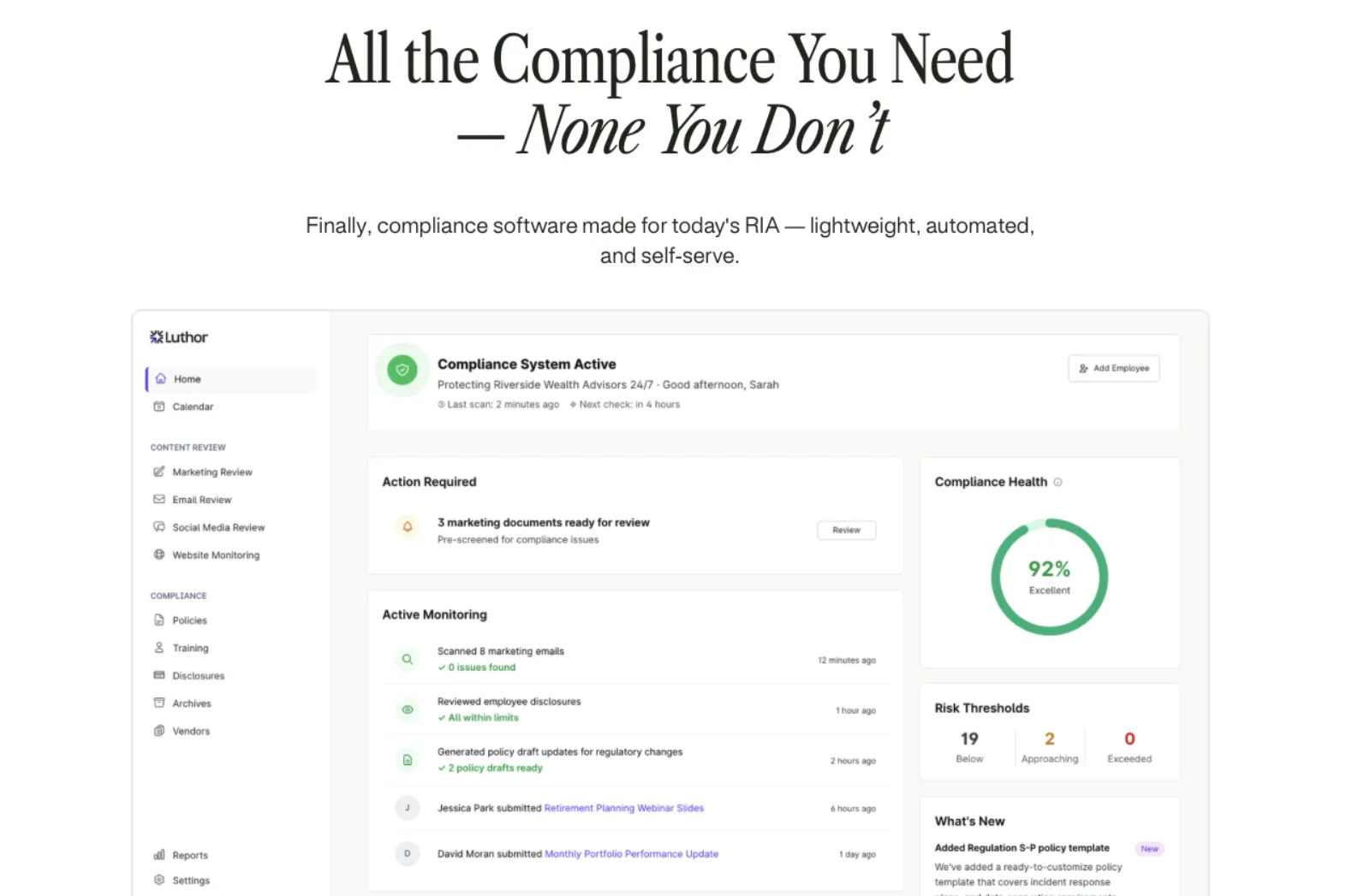
FINRA advertising regulations require broker-dealers to maintain principal review of retail communications and preserve approval records. Most compliance software documents approvals but doesn't prevent violations.
Luthor catches violations before publication. The AI engine identifies prohibited claims, missing disclosures, and non-compliant language across all content types including video and audio. When complex questions arise, you escalate directly to former regulators who understand broker-dealer compliance strategy.
Post-publication monitoring separates Luthor from alternatives. We scan adviser pages and social feeds continuously, flagging unapproved edits automatically.
Specialized AI models, real-time oversight, and expert escalation paths deliver faster approvals with lower risk than workflow-only tools.
FAQs
Can marketing approval software monitor content after it's published?
Luthor is one of the few platforms built especially for continuous post-publication monitoring of live adviser pages and social feeds, automatically flagging unapproved edits after content goes live. Some solutions focus on pre-publication review and may offer post-publication monitoring in periodic scans or limited channel coverage, meaning content can drift out of compliance between reviews without timely detection.
What's the difference between workflow software and compliance review platforms?
Workflow software routes content through approval steps and documents decisions. Compliance review platforms like Luthor and Saifr add AI detection that flags FINRA 2210 violations, missing disclosures, and prohibited claims before human reviewers see the content, reducing review time and error rates.
Do I need separate tools for different marketing channels?
No. Multi-channel platforms like Luthor handle web pages, emails, social posts, PDFs, video, and audio through one review process with consistent rules. Single-channel tools force you to manage separate workflows for each content type, creating gaps in coverage and inconsistent standards.
What should broker-dealers document when AI is used in marketing review?
Broker-dealers should retain the draft communication, AI findings, prompt or instruction context where relevant, model or ruleset version, reviewer decision, approval timestamp, requested edits, final version, first-use date, and any override rationale. The practical goal is to show that AI supported the supervisory process without replacing required human review.
How should marketing approval software handle influencer content?
The workflow should capture influencer or third-party content before use when it is posted on the firm's behalf, route static content to the right reviewer, preserve the final post and approval evidence, and monitor for unapproved edits or deleted disclosures after publication.
Final thoughts on marketing approval workflow solutions
FINRA 2210 approval demands more than routing content and storing files after the fact. Broker-dealers need systems that surface violations across web pages, social posts, email, mobile prompts, influencer content, non-English communications, and multimedia before content is published and continue watching for changes after it goes live. Luthor's marketing approval workflow software brings those capabilities together by combining AI-based screening, post-publication monitoring, exam-ready recordkeeping, and access to seasoned compliance professionals, giving firms a practical way to keep pace with adviser marketing while staying prepared for exams.
Keep reading
Related resources

Guides
How to Use AI for Marketing Compliance in 2026
A practical 2026 guide to AI marketing compliance: agent supervision, review workflows, privacy controls, audit trails, and human approval for regulated teams.
16 min

Guides
FINRA Advertising Rules: Compliance for Rule 2210 and Private Placements
FINRA advertising rules & compliance: Guide to Rule 2210, enforcement, and best practices for brokers.
14 min

Glossary
SEC Rule 17a-4: Recordkeeping Compliance for Broker-Dealers
SEC Rule 17a-4 compliance guide for broker-dealers: implications, and recordkeeping requirements.
6 min



Never publish risk again.
Our policy and legal engineers will walk through your content workflows and regulatory obligations, then integrate Luthor in days, not months.