Guides
Best Compliance Archiving Solutions with AI Review for Fintechs in January 2026
Compare the best compliance archiving solutions with AI review for fintechs. SEC 17a-4 WORM storage, real-time content scanning, and audit trails. January 2026.
Luthor Team··7 min read
Article details
- Written by
- Luthor Team
- Topic
- Guides
- Published
- Jan 17, 2026
- Last updated
- Jan 17, 2026
- Reviewed by
- Luthor Team
Reviewed Jan 17, 2026 for source quality, practical relevance, and regulated-marketing context.
Fintech marketing teams are publishing more content than ever, yet compliance review and record retention remain persistent friction points. Regulators continue to cite firms for missed advertising violations and incomplete archives that fail SEC and FINRA recordkeeping standards. Manual review slows campaigns, while basic archiving systems store content without catching problems as they happen. As a result, many fintechs are adopting AI compliance archiving software that pairs real-time content scanning with tamper-evident storage, allowing teams to identify violations before and after publication while retaining exam-ready records across web, email, social, video, and audio channels.
TLDR:
- Compliance archiving with AI review pairs WORM storage for SEC 17a-4 with real-time scanning for violations.
- Some modern systems scan web, email, social, video, and audio content for regulatory risks before and after publication.
- AI models designed to reflect SEC and FINRA advertising rules catch performance claims and missing disclosures automatically.
- Tamper-evident archiving tracks every edit and approval for exam-ready audit trails.
- Certain solutions combine AI review, continuous monitoring, compliant storage, and expert support in one system.
What Is Compliance Archiving with AI Review for Fintechs?
Compliance archiving with AI review combines tamper-proof recordkeeping and proactive content screening. Traditional archiving systems capture and store communications to satisfy SEC Rule 17a-4 and FINRA Rule 4511 recordkeeping expectations. Broker-dealers must preserve required records under SEC Rule 17a-4 (including specific requirements for electronic recordkeeping), and many advisors adopt similar immutable retention practices as a best practice.
AI review adds real-time scanning. The system checks marketing content, emails, social posts, and web pages for regulatory violations as they're created and after publication. You store evidence for exams while catching performance claims, missing disclosures, and prohibited language before regulators do.
For fintechs publishing frequently, this dual capability meets retention obligations while avoiding exam findings that come from manual-only review.
How We Ranked Compliance Archiving Solutions with AI Review
We assessed each solution against six criteria that matter for fintech compliance teams managing high-volume marketing and communications.
First, WORM storage designed to meet SEC Rule 17a-4 requirements makes records tamper-proof and legally defensible. Second, AI review capabilities designed to reflect SEC and FINRA advertising rules, not generic content policies. Third, multi-channel coverage that handles web pages, email, social media, video, and audio in one workflow.
Fourth, implementation and integration with existing CMS, email, and social scheduling tools. Fifth, audit trail completeness and one-click reporting for exam requests. Sixth, access to human compliance experts for edge cases AI can't resolve alone. Common compliance findings across financial firms often involve incomplete recordkeeping and missed advertising/disclosure issues.
Luthor
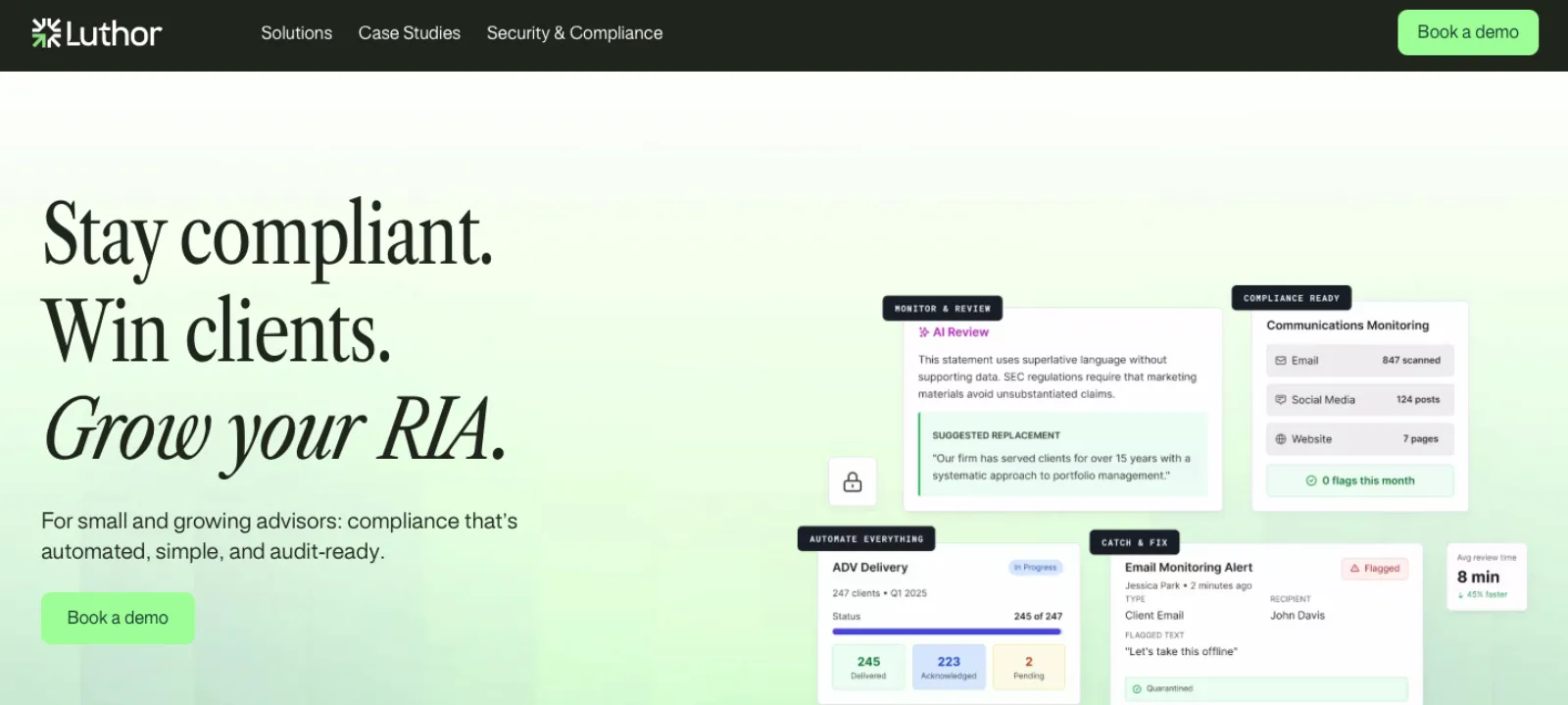
Luthor is an AI-powered marketing review and archiving solution built for regulated financial firms that need to accelerate content approvals while maintaining SEC and FINRA compliance. The system pairs an AI review engine trained on advertising rules with automated WORM-style archiving, real-time monitoring across channels, and access to human compliance experts.
What Luthor Offers
- AI Marketing Review Assistant that scans web pages, emails, social posts, video, and audio content for performance claims, testimonials, missing disclosures, and violations across multiple languages
- Automated auditing with tamper-evident WORM storage that satisfies SEC Rule 17a-4, tracking every version, edit, approval, and publication event
- Real-time monitoring that helps detect unapproved edits to live websites, advisor pages, and social feeds, routing changed content back through review
- Custom rules that encode firm-specific marketing policies on top of regulatory requirements, with instant risk alerts and suggested fixes
- Dedicated expert support from former regulators and CCOs for high-risk campaigns
Luthor handles the full marketing compliance lifecycle with AI-first review, continuous monitoring, and exam-ready archiving in one workflow.
Kadince
Kadince provides marketing compliance workflow tools for financial services firms with structured approval processes and content management needs.
What They Offer
- Marketing review workflows with approval routing and content versioning
- Policy library and disclosure management for standardized language
- Content storage and basic archiving functionality
- Collaboration tools for marketing and compliance teams
Good for: Firms with existing compliance processes that need workflow automation and content organization.
Limitation: AI-assisted scanning is available, but depth of regulatory detection, post-publication monitoring, and coverage for video/audio varies by implementation. Many teams still rely on manual compliance judgment. Advanced features like in-depth video/audio review and real-time website monitoring may require additional tooling or integrations, depending on the firm’s setup.
IntelligenceBank
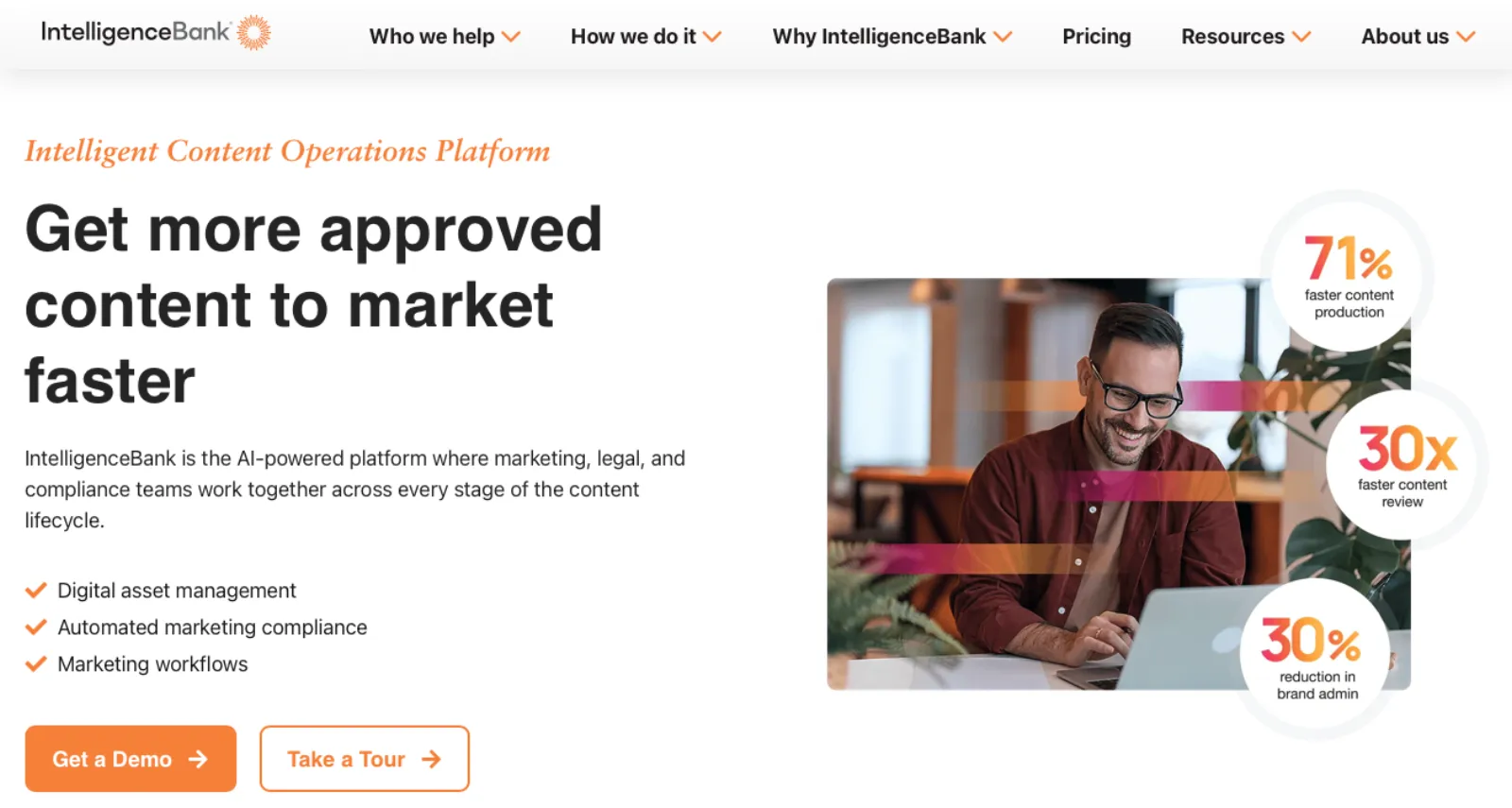
IntelligenceBank is a content operations system combining digital asset management with marketing workflow and compliance capabilities, with SEC Rule 17a-4–aligned immutable retention announced in 2025 (often referenced in industry materials as “FINRA 17a-4” retention).
What They Offer
- Digital asset management with metadata tagging and version control
- Marketing workflow and approval process management
- SEC Rule 17a-4 compliant storage for record retention
- Customizable brand portals and permission controls
Good for: Enterprises with complex digital asset libraries that need centralized content management, brand governance, and compliant storage within a single system.
Limitation: Built primarily as a digital asset management tool instead of a compliance-first solution. Lacks specialized AI models trained on financial advertising regulations. No proactive content monitoring after publication.
Saifr
Saifr is an AI compliance review tool incubated by Fidelity Labs that scans financial marketing content for compliance and brand risks.
What They Offer
- AI-powered scanning that flags compliance risks in text, images, and videos
- Collaborative workflow for content creation and approval
- Detection of performance claims, testimonials, comparisons, and disclosure issues
- API and software add-in access for integration with existing tools
Good for: Large financial institutions with dedicated compliance teams that need AI assistance for first-pass content reviews.
Limitation: Does not provide native archiving or WORM storage capabilities. Firms must integrate separate recordkeeping systems to meet SEC Rule 17a-4 requirements.
Red Oak Compliance
Red Oak Compliance offers advertising and marketing review software, with optional consulting support to help teams implement and manage their review programs.
What They Offer
- Human compliance reviewers handle advertising review work
- Submission tracking and approval workflow tools
- Regulatory guidance, training, and policy development support
Good for: Firms that want fully outsourced compliance review with human experts managing most review tasks instead of software automation.
Limitation: Outcomes depend on how much review is handled via software versus consulting support; firms seeking fully automated, always-on monitoring and archiving may still need additional tooling depending on their requirements.
Why Luthor Is the Best Compliance Archiving Solution with AI Review for Fintechs
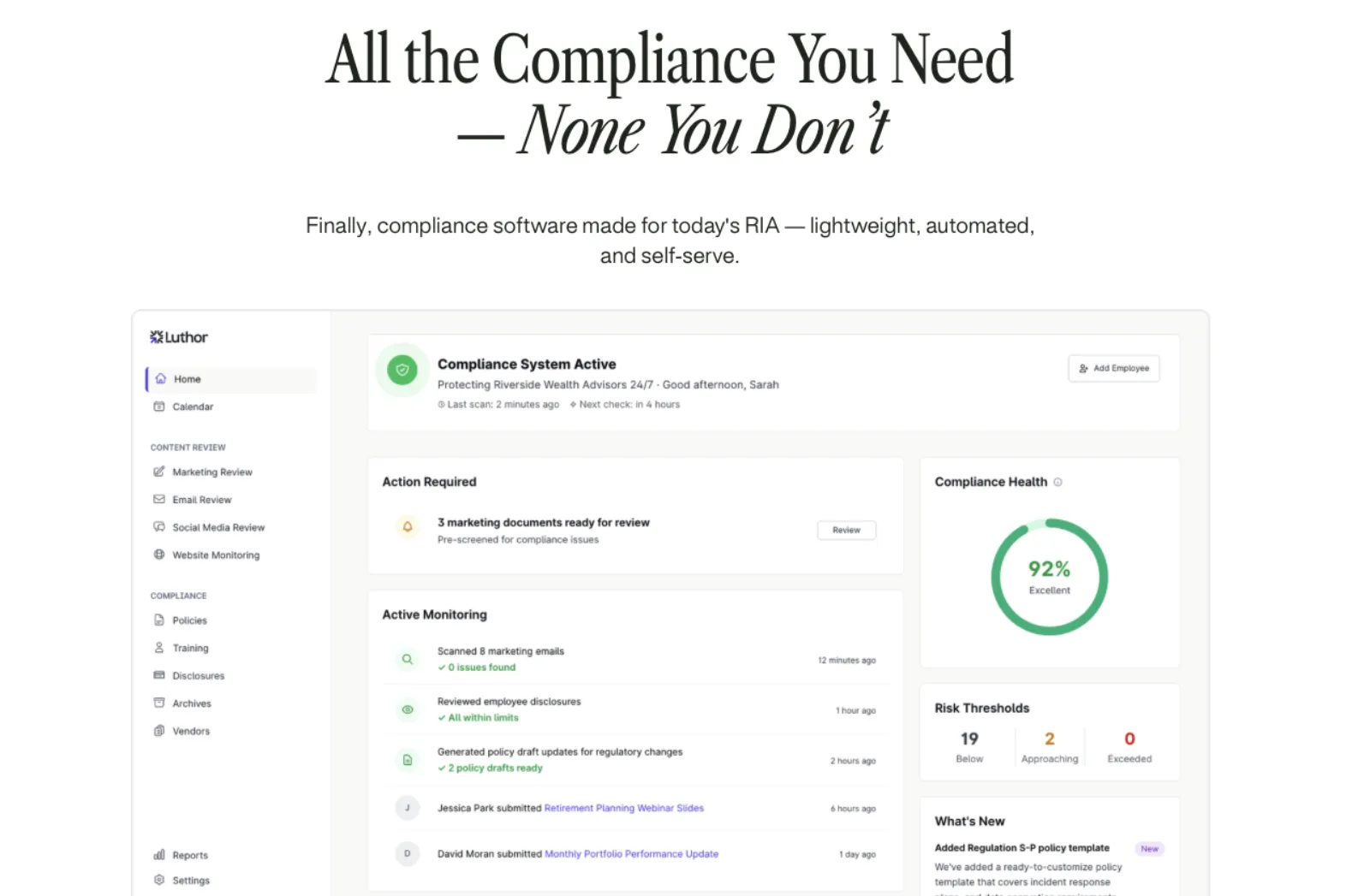
Luthor unifies AI-powered review, continuous monitoring, and compliant archiving in one system built for financial services. Competitors offer archiving without intelligent review, AI scanning without recordkeeping, or services-heavy models that can't match software speed.
Our proprietary AI models are designed to catch subtle violations while reducing false positives compared to generic content scanners. The engine handles video, audio, and multilanguage content that other tools ignore. Real-time monitoring detects post-publication changes automatically.
Tamper-evident WORM storage satisfies SEC Rule 17a-4 requirements while audit trails capture every decision for exam readiness. When edge cases arise, you get access to former regulators and CCOs.
For fintechs publishing dozens of pieces weekly under SEC and FINRA scrutiny, we compress review cycles while maintaining complete documentation.
FAQs
How do I choose the right compliance archiving solution for my fintech?
Start with your content volume and channels. If you publish dozens of pieces weekly across web, email, social, video, and audio, you need AI review plus WORM storage in one system. If you publish infrequently and have a large compliance team, workflow-only tools may suffice. Match the solution to your throughput and staffing reality.
Which compliance archiving tool works best for small fintechs without dedicated compliance teams?
Solutions that combine AI review with expert support work best for lean teams. You need software that automates routine checks and flags violations automatically, plus access to human compliance professionals for complex judgment calls. Avoid tools that require you to build rule sets from scratch or manage separate archiving systems.
Can compliance archiving solutions handle video and audio content?
Many archiving tools store video and audio files without analyzing them. AI-powered solutions like Luthor scan video and audio transcripts for performance claims, testimonials, and missing disclosures. If you publish webinars, podcasts, or video ads, verify the system reviews spoken content.
What's the difference between WORM storage and regular archiving?
WORM (Write Once, Read Many) storage creates tamper-proof records that satisfy SEC Rule 17a-4. Once content is written, it cannot be altered or deleted. Regular archiving allows edits and deletions, which fails regulatory requirements. For broker-dealers, WORM storage is mandatory; many advisors adopt it as a best practice.
When should I add real-time monitoring to my compliance archiving setup?
Add monitoring if your marketing team or advisors can edit live web pages, social profiles, or email templates after initial approval. Real-time monitoring detects post-publication changes and routes modified content back through review. Without it, previously compliant materials drift out of compliance between exams.
Final Thoughts on Compliance Archiving and AI Review
Combining compliance archiving with AI-driven review changes how fintechs manage regulatory exposure across fast-moving marketing channels. WORM storage alone preserves records, but it doesn’t prevent violations; AI review alone flags issues, but without defensible retention it leaves gaps during exams. Solutions like Luthor connect both sides of the requirement, scanning content before and after publication while retaining tamper-evident records that meet SEC and FINRA rules. This approach reduces reliance on manual checks, shortens approval cycles, and captures every edit, approval, and publication event in a single history. For fintechs producing high volumes of web content, emails, social posts, videos, and audio, Luthor supports faster execution without sacrificing regulatory control, helping teams stay prepared for exams while keeping marketing output moving forward.
Keep reading
Related resources

Guides
The Meaning of Compliance and an Era of Change for Banks, RIAs, and Fintechs
Learn the meaning of regulatory and corporate compliance and its impact on the operations of banks, RIAs, and fintechs.
15 min

Guides
Guide to the Regulatory Agencies in the U.S. Financial Industry
Discover the 20 major regulatory agencies that rule financial industry & learn how they impact banks, RIAs, and fintechs
18 min

Guides
What Is a Compliance Checklist? And How Can Banks, RIAs, and Fintechs Create One?
Discover what a compliance checklist is and how to create one to streamline AML/KYC and consumer protection.
7 min



Never publish risk again.
Our policy and legal engineers will walk through your content workflows and regulatory obligations, then integrate Luthor in days, not months.