Guides
FINRA Advertising Rules: Compliance for Rule 2210 and Private Placements
FINRA advertising rules & compliance: Guide to Rule 2210, enforcement, and best practices for brokers.
Luthor Team··14 min read
Article details
- Written by
- Luthor Team
- Topic
- Guides
- Published
- Nov 3, 2025
- Last updated
- Nov 3, 2025
- Reviewed by
- Luthor Team
Reviewed Nov 3, 2025 for source quality, practical relevance, and regulated-marketing context.
Financial firms deal with strict oversight on their public communications. With FINRA bringing its first enforcement case against a broker-dealer's social media "finfluencer" program in 2024 (fining the firm $850,000 for posts that weren't fair and balanced), the stakes are pretty high. At the same time, companies are raising substantially more capital through private offerings than public markets—nearly $949 billion in exempt offerings versus only $28 billion via IPOs in a recent 12-month period.
This article examines FINRA's advertising regulations (particularly FINRA Rule 2210) and private placement compliance, using data and research from 2023-2025 to show their business impact.
What is FINRA and Its Role in Compliance?
The Financial Industry Regulatory Authority (FINRA) is the self-regulatory organization overseeing U.S. broker-dealers under SEC supervision. FINRA's job is to protect investors and promote market integrity by monitoring broker-dealer conduct. It's a not-for-profit SRO funded by member firms (not taxpayers) and is governed by a board with a majority of public members.
FINRA operates on a large scale—as of 2023, it oversaw about 3,300 brokerage firms and around 625,000 registered representatives across the country. FINRA's annual budget supports an organization of about 4,000 employees dedicated to regulatory programs. The SEC closely supervises FINRA, reviewing its rules and examining FINRA's programs regularly to make sure FINRA itself stays accountable.
Purpose of FINRA in the Financial Industry
In practice, FINRA writes and enforces rules for brokers, examines firms for compliance, and educates industry participants. It serves as the front-line regulator for broker-dealers, handling tasks that might otherwise fall to the SEC adding to the long list of banking regulatory agencies.
FINRA's reach is visible in its workload: it regulates thousands of firms and hundreds of thousands of individuals, meaning it monitors enormous volumes of transactions and communications. For example, FINRA's Advertising Regulation Department reviewed over 63,000 communications filings in 2023 alone—these are ads, social media posts, brochures, and other public materials that firms submitted for compliance review.
FINRA also operates systems like BrokerCheck (a public database of broker credentials) and the Central Registration Depository (CRD) for licensing, which support transparency for investors. Overall, FINRA's purpose is to make brokers and firms follow the rules and to intervene when investors are at risk, thereby maintaining trust in the securities industry.
How FINRA Ensures Compliance?

FINRA employs a combination of routine examinations, continuous surveillance, and enforcement actions so that member firms will comply with regulations. Each broker-dealer is subject to a regular inspection cycle (frequency based on the firm's risk profile) and to targeted "sweeps" on emerging issues.
FINRA staff use advanced surveillance technology to flag potential rule breaches—for instance, FINRA conducts cross-market oversight of trading activity and can spot unusual patterns across exchanges. When violations are found, FINRA's Enforcement arm takes action.
In 2023, FINRA reported 453 disciplinary actions against firms/individuals (a slight drop from the prior year) and imposed $89 million in fines. These cases ranged from sales practice abuses to recordkeeping failures. FINRA also ordered restitution to harmed investors and barred or suspended dozens of brokers from the industry.
To guide compliance proactively, FINRA issues detailed annual Regulatory Oversight Reports with common exam findings and "effective practices"—for example, the 2024 report gave guidance on supervising mobile app communications and off-channel messaging. In short, FINRA works on compliance through ongoing supervision of firms (with exams and surveillance) and deterrence (through enforcement when violations occur).
Key Regulatory Functions of FINRA
Some of FINRA's key regulatory functions include:
- Member Firm Regulation—Examinations and Risk Monitoring: FINRA conducts on-site and remote exams of broker-dealers to verify compliance with rules on sales practices, advertising, anti-fraud, anti-money laundering, etc. It performs hundreds of exams each year (each firm is typically examined at least once every few years). FINRA's Member Supervision program also continuously monitors firms' filings and disclosures to identify risks.
- Enforcement: FINRA enforces its own rules as well as federal securities laws by bringing disciplinary actions. In 2023, for example, FINRA brought 453 cases and issued 14 "supersized" fines over $1 million each. Top enforcement issues in recent years have included manipulation (e.g. spoofing), communications violations, failure to supervise, and sales of unsuitable products. FINRA can impose sanctions such as fines, suspensions, industry bars, and ordering compensation to investors.
- Rulemaking and Guidance: FINRA drafts rules that govern broker-dealer conduct (subject to SEC approval). It also publishes Regulatory Notices and FAQs to clarify rules. For instance, FINRA has issued notices on how firms should handle crypto-asset communications and private placement due diligence. These rules and notices form the compliance framework firms must follow.
- Market Transparency and Other Services: FINRA operates systems like TRACE (Trade Reporting and Compliance Engine for bonds) to increase market transparency. It also runs the largest securities arbitration forum, handling thousands of disputes between investors and brokers each year. These functions support fair markets and resolution of issues when compliance fails.
Through these functions, FINRA acts as the industry's watchdog—setting standards, checking for problems, and responding to misconduct—in order to maintain confidence in the brokerage sector.
What Are the FINRA Rule 2210 Requirements?

FINRA Rule 2210 is the chief rule governing broker-dealers' communications with the public. It sets out approval, content, and recordkeeping requirements for virtually all forms of public communication by FINRA members. Key mandates of Rule 2210 include:
- Classification of Communications: Every public communication falls into one of three categories—"Retail communication," "Correspondence," or "Institutional communication." Retail communications are materials distributed to more than 25 retail investors within a 30-day period; correspondence is to 25 or fewer retail investors; institutional communications are solely for institutional audiences. The classification determines approval and filing obligations.
- Principal Approval: Except for certain exempted cases, a qualified registered principal must pre-approve each retail communication before use or filing. This means firms must have supervisors review advertisements, social media posts, sales brochures, etc., before they are published to retail investors. (Institutional communications require supervision but not necessarily pre-approval, and correspondence is subject to after-the-fact review under firms' procedures.) New member firms have an extra duty to file their broadly disseminated retail communications with FINRA 10 business days prior to first use during their first year of membership.
- Filing with FINRA: Rule 2210 requires firms to file certain communications with FINRA's Advertising Regulation Department. For example, investment company retail communications (e.g. mutual fund ads), variable insurance product retail communications, and others must be filed within 10 business days of first use. New firms, as noted, must file most retail materials 10 days in advance. FINRA may also spot-check any communication at any time. Firms file materials through FINRA's online system and FINRA provides a written review/comment letter for each filing.
- Content Standards: The rule imposes strict standards to make sure communications are truthful and not misleading. All communications must be fair and balanced, and must provide a sound basis for evaluating the investment being discussed. They may not contain any false, exaggerated or promissory statements or omit material facts such that the communication would mislead the reader. Importantly, any specific claim of benefit must be balanced by disclosure of key risks or limitations associated with the product/service. There are detailed provisions banning performance projections (with limited exceptions), requiring certain disclaimers, and more (e.g. communications can't predict future results or imply past performance will recur).
- Recordkeeping: Firms must maintain files of all communications, with records of the date, who approved them, and when/how they were used, as required under Rule 2210(b) and SEC recordkeeping rules. Generally, records must be kept for at least 3 years.
To sum up, Rule 2210 requires brokers to get approval on retail communications, file specified materials with FINRA, and adhere to truth-in-advertising standards. These requirements apply to communications in any medium—print, websites, social media, videos, etc.—all must meet the same high bar for accuracy and balance.
What is Rule 2210?
FINRA provides extensive guidance to help firms understand and comply with Rule 2210. The core principle is that the content of a communication—not the medium—dictates the regulatory standards. Even as new digital channels emerge, the rule's framework has proven flexible by focusing on principles.
FINRA regularly updates guidance in areas such as social media, which Rule 2210 covers (there is no "social media exemption"—communications on Twitter or TikTok must be compliant like any others). In 2023, FINRA even proposed amendments to Rule 2210 to accommodate modern practices: one proposal would allow certain performance projections in communications exclusively to institutional investors or qualified purchasers, which are currently prohibited for retail communications.
(Under the rule today, firms generally cannot include predictions or "target returns" in ads, except in hypothetical scenarios or certain tools.) This proposed change—filed with the SEC in Nov. 2023—recognizes that sophisticated audiences might benefit from more tailored content.
FINRA's Advertising Regulation FAQ (updated frequently on FINRA's website) is an excellent resource that explains Rule 2210 in plain language—addressing questions like "Do tweets need principal approval?" or how to treat sharing of third-party content. Additionally, FINRA's annual conferences and webinars often feature advertising compliance sessions, and in 2024 FINRA staff highlighted common Rule 2210 misconceptions (for instance, reminding firms that a broker's personal communications can become subject to Rule 2210 if they stray into business discussions).
All of these resources reinforce the rule's key aim: any public-facing communication by a broker-dealer should not be misleading and has to serve investors fairly.
Key Provisions of Rule 2210
In short, here are some of Rule 2210's key provisions and what they mean for firms' communications:
- Categorization of Audience: Communications are categorized as Retail, Correspondence, or Institutional, with retail communications (over 25 retail recipients) carrying the most requirements. This means if a message could reach a broad retail audience—e.g. a public website post or mass marketing email—it is held to the retail standard.
- Principal Approval Required: All retail communications must be approved by a registered principal before first use (with narrow exceptions). This pre-approval requirement forces firms to implement internal review workflows—typically, compliance or supervisory principals vet content for compliance with the rule's standards. If a social media post or advertisement hasn't been principal-approved, it cannot be disseminated to more than 25 retail investors.
- Filing with FINRA: Certain communications (not all) must be filed with FINRA's Advertising Regulation Department for review and record. These include, for example, new member firms' retail communications (during first year), and any retail communications promoting specific investment products like mutual funds, ETFs, variable annuities, direct participation programs, etc. Filings generally must be made within 10 business days of first use (or prior to use for some new firms or certain types). FINRA does not "pre-approve" ads in most cases, but will issue a comment letter if it finds the material non-compliant, and firms must address those comments.
- Content Standards—Fair and Balanced: Every communication is subject to general anti-fraud content standards. This includes the requirements that statements be fair and balanced and not misleading by omission. Firms cannot use superlatives or unwarranted claims ("#1 best returns guaranteed!" would be a red flag). Any benefits cited must be accompanied by relevant risks or caveats to avoid painting a one-sided picture. Historical performance can be stated (with required disclaimers that past performance is not indicative of future results), but projecting future performance or specific investment outcomes is largely prohibited.
- Name and Identity Disclosure: All retail communications and correspondence must prominently display the broker-dealer's name and reflect any affiliations clearly. Anonymous or misleadingly branded promotions are not allowed. This provision allows investors to know who is behind a communication.
- Recordkeeping: Firms must maintain records of communications and approvals. For any retail or institutional communication, if it wasn't pre-approved, the firm must keep a record of who prepared it and who ultimately approved it (even if post-use). This ties into SEC Rule 17a-4's recordkeeping requirements as well. Essentially, every tweet, email or flyer related to the firm's business must be stored for at least three years with data on who approved it and when.
By adhering to these provisions, firms can allow their communications to meet FINRA's standards. Rule 2210 is quite comprehensive, but FINRA's emphasis is on principles—honesty, clarity, and balance—that apply universally.
How to Comply with FINRA Rule 2210?
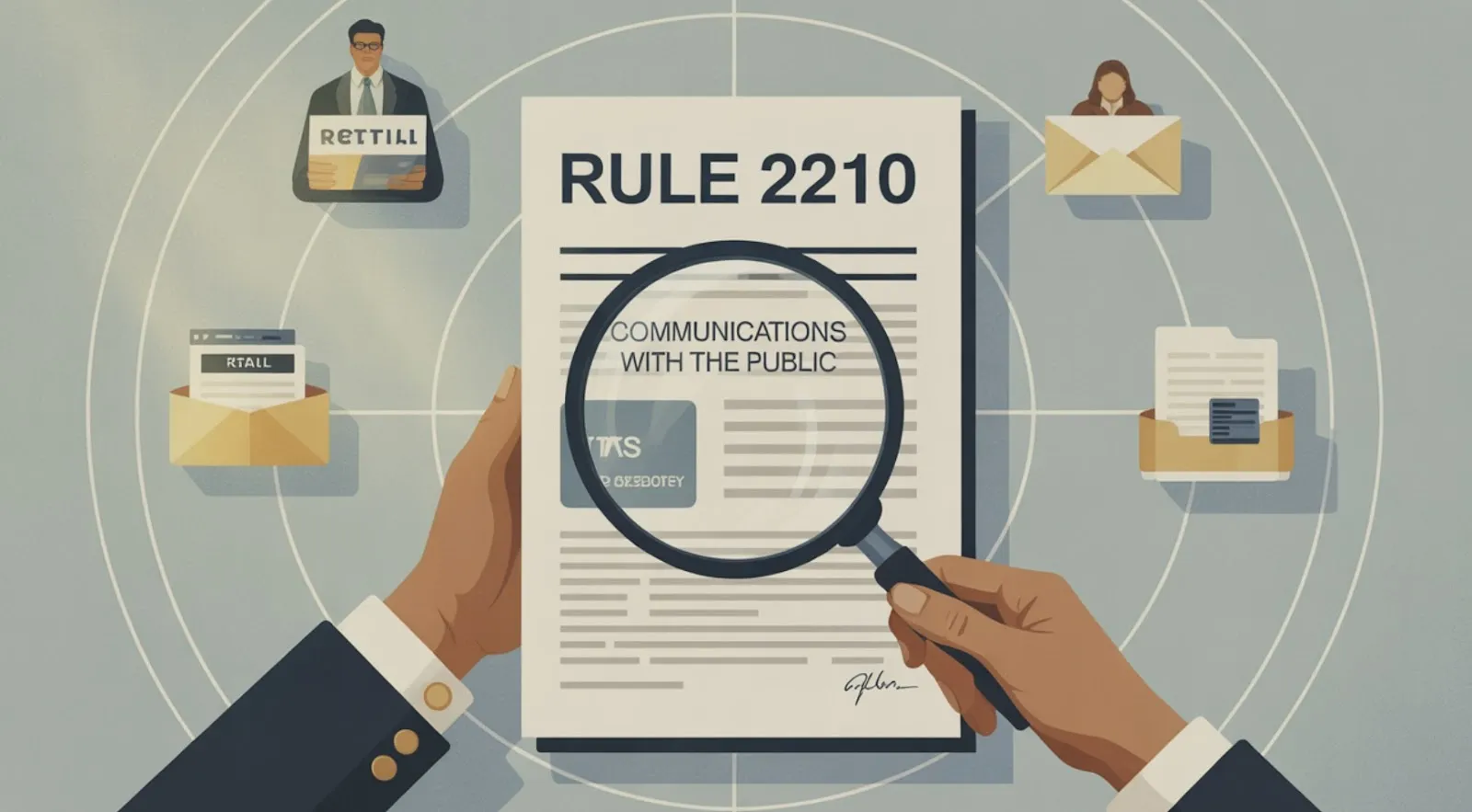
Given the breadth of Rule 2210, broker-dealers must have a robust compliance program for communications. Some best practices and official guidance for complying include:
- Establish a Review Process: Firms should implement a clear internal process where all retail communications flow to compliance supervisors before release. This typically means maintaining an archive of draft ads, social media content calendars, email templates, etc., that designated principals review and sign off on. FINRA encourages use of checklists to make sure communications include required disclosures and avoid prohibited language. For example, a checklist may remind reviewers to verify that any discussion of product benefits is accompanied by risk disclosure (a common area where FINRA finds deficiencies).
- Leverage FINRA's Filing Program: When in doubt, firms can voluntarily file materials with FINRA's Advertising Regulation Department—even if not strictly required—to get feedback. FINRA provides written comment letters on filed communications. Many firms use this as a safeguard. If a firm needs a quick turnaround—say for a time-sensitive marketing campaign—FINRA offers an expedited review service (for a fee) that guarantees comments within three business days.
- Train Representatives on Communication Rules: Compliance with Rule 2210 isn't just a back-office function; brokers and advisors themselves must understand what they can/can't say in public forums. FINRA has stressed the importance of training associated persons on differentiating personal vs. business communications.
- Use Disclaimers and Balanced Language: In practical terms, complying with Rule 2210 means always adding appropriate disclaimers and balancing language in communications. For instance, if performance of an investment is mentioned, include a prominent "past performance is not indicative of future results" notice. If discussing a complex product (options, crypto, etc.), clearly state key risks (volatility, potential loss of principal, etc.) near the optimistic statements.
- Monitor Third-Party Communications: If the firm uses third-party content—testimonials, social media influencers, referral programs—those too must be compliant. Recent cases show FINRA will hold firms accountable for influencer posts as if the firm itself made the statements. So, compliance should extend to reviewing what others are saying on the firm's behalf. Firms can mitigate risk by providing pre-approved content or scripts to affiliates/influencers and by supervising those communications closely.
By implementing these steps—pre-approval workflows, thorough training, judicious use of FINRA's review, and careful crafting of content—firms can substantially reduce the risk of Rule 2210 violations. FINRA's own materials (such as the Advertising Regulation Department's published guidance and FAQs) are invaluable in helping compliance staff stay current on expectations.
Common Issues in Advertising Regulation

Despite the rules and reviews, certain compliance issues in advertising recur frequently. Knowing these common pitfalls can help firms avoid enforcement trouble. Recent data and cases (2023-2024) point to several problematic areas:
- Lack of Balanced Risk Disclosure: FINRA finds that firms often emphasize benefits without equal disclosure of risks. In its 2024 oversight report, FINRA noted instances of promotions for high-risk products (like options or crypto assets) that touted potential gains or features but failed to clearly disclose the risk of loss or other key risks. For example, some mobile app notifications encouraged customers to trade options ("don't miss out on extra income!") without mentioning that options carry the risk of losses—a clear Rule 2210 violation.
- Misleading Claims and "Cherry-Picking": Another common violation is making misleading or absolute claims. FINRA has cited firms for using phrases like "always pays a dividend" or "guaranteed income" in communications when such outcomes are not guaranteed. Similarly, selectively talking only about successful investment results (cherry-picking data) while ignoring negative outcomes is misleading.
- Improper Use of Social Media Influencers: With the rise of "finfluencers," FINRA has observed firms stumbling in how they supervise these third-party promoters. Posts by influencers often weren't approved or reviewed by the firm and ended up containing exaggerated, promissory language.
- Off-Channel Communications (Recordkeeping failures): While not an "advertising" issue per se, a related compliance gap has been brokers using texting, WhatsApp, or personal email for business communications and not retaining those messages. This became a huge regulatory sweep in 2023 (led by the SEC, with FINRA parallel actions) resulting in massive fines.
- Non-compliance in Private Placement Marketing: FINRA's exams have uncovered that marketing materials for private placements sometimes contain misrepresentations or omissions. A common issue is overstating the issuer's prospects—e.g., presenting projected returns or comparisons that imply safety. In Regulatory Notice 23-08, FINRA warned that some private offering decks failed to disclose pertinent negatives (like an issuer's lack of operating history or conflicts of interest).
In essence, the common issues boil down to truthfulness and balance. When firms fail to present communications that meet those criteria, FINRA takes issue. The best defense for firms is to scrutinize every communication with a skeptical eye: Would an average investor be misled or overly optimistic by this message? If yes, it likely needs revision.
FAQs on Communications with the Public
To wrap up, here are a few frequently asked questions about communications rules that firms often have—especially as new technology blurs the lines of "communication":
Q: Are text messages and chat apps covered by FINRA communication rules?
A: Yes. Any business-related communication, regardless of medium, is covered. FINRA explicitly states that it's the content, not the device or app, that matters. If a registered rep texts a client about their account or an investment idea, that text is subject to the same rules as an email or letter would be. Firms must retain those messages and supervise them.
Q: Can brokers use personal social media accounts to talk about investing?
A: They can, but if they do, it becomes a business communication and all the rules apply. FINRA doesn't forbid use of personal social media for business—however, the firm must supervise it. Personal posts unrelated to business are outside FINRA's scope (brokers can post vacation photos or opinions on sports freely). But the moment personal social media is used for anything business-related, it's subject to FINRA rules.
Q: Do "likes" or sharing someone else's post count as communication by the firm?
A: This is nuanced. FINRA has said that if a firm or its rep "likes" or shares/retweets a third-party post, it is adopting that content and therefore is responsible for it under the communication rules. For instance, if a broker shares an article that makes an investment recommendation, that share is effectively the broker also making that recommendation—so it must be suitable and fair.
Q: How does FINRA Rule 2210 interact with SEC advertising rules for investment advisers?
A: Some firms are dual-registrants (broker-dealer and investment adviser). They have to comply with both FINRA's rules and the SEC's Investment Adviser Marketing Rule (amended in 2021). The SEC's rule now allows testimonials and endorsements for advisers under certain conditions, whereas FINRA already allowed them for brokers with proper disclosure. Generally, complying with FINRA 2210 puts a firm in a good position to comply with SEC rules too, because FINRA's standards for fairness are high.
Final Thoughts
FINRA's oversight of advertising and communications—encompassing Rule 2210 for public communications and Rules 5122/5123 for private placement filings—is a critical component of investor protection in today's financial world. The sheer volume of material under FINRA's watch is tens of thousands of advertisements and communications reviewed annually, and thousands of private offering filings flowing in each year as the private markets boom.
With firms leveraging new digital channels and capital raising methods, FINRA's role continues to expand and adapt. The data and cases from 2023-2025 show that while mediums change (from print, to Twitter, to TikTok), the core risks remain—misleading information can hurt investors and erode trust in markets.
Marketing compliance doesn't have to be a burden on your team. At Luthor, we understand the challenges financial firms face when trying to create effective marketing assets while trying to figure out FINRA's complex regulatory rules.
Our AI-based compliance review tool allows you to automatically review all your marketing assets for compliance issues—catching potential problems before they lead to regulatory action. You can:
- Quickly scan communications for Rule 2210 violations
- Identify missing disclosures and imbalanced risk statements
- Flag problematic language and claims
- Keep comprehensive records of reviews and approvals
- Streamline your compliance workflow
With Luthor, you can reduce the risk, effort, and time needed to tackle marketing compliance at scale.
Interested in seeing how Luthor can transform your compliance process? Request a demo access today and discover a more efficient way to maintain compliant communications.
Keep reading
Related resources

Guides
The Meaning of Compliance and an Era of Change for Banks, RIAs, and Fintechs
Learn the meaning of regulatory and corporate compliance and its impact on the operations of banks, RIAs, and fintechs.
15 min

Guides
Guide to the Regulatory Agencies in the U.S. Financial Industry
Discover the 20 major regulatory agencies that rule financial industry & learn how they impact banks, RIAs, and fintechs
18 min

Guides
What Is a Compliance Checklist? And How Can Banks, RIAs, and Fintechs Create One?
Discover what a compliance checklist is and how to create one to streamline AML/KYC and consumer protection.
7 min



Never publish risk again.
Our policy and legal engineers will walk through your content workflows and regulatory obligations, then integrate Luthor in days, not months.