Glossary
ADA Website Compliance: The Complete Guide for Marketing Teams in 2025
Make sure your website meets ADA compliance and accessibility standards with out comprehensive guide.
Luthor Team··8 min read
Article details
- Written by
- Luthor Team
- Topic
- Glossary
- Published
- Jan 7, 2026
- Last updated
- Jan 7, 2026
- Reviewed by
- Luthor Team
Reviewed Jan 7, 2026 for source quality, practical relevance, and regulated-marketing context.
Right now, 1 in 4 Americans (over 61 million people) live with some form of disability, and globally over 1.3 billion people (15-20% of the population) experience disabilities. Together with their families, they control an estimated $13 trillion in annual spending.
Yet here's the reality check: an astonishing 96.3% of top website homepages had detectable web accessibility failures as of 2023.
And the consequences? They're real and growing. Over 4,600 ADA web accessibility lawsuits were filed in 2023 alone—and that's not counting the thousands of demand letters sent privately to businesses.
For marketing teams, this creates a perfect storm of risk. You work hard to create and launch campaigns, but accessibility issues can derail your efforts, expose your company to legal action, and alienate a huge segment of potential customers.
In this guide, we'll walk you through everything you need to know about ADA website compliance—from knowing the legal requirements to implementing practical solutions that protect your marketing assets while creating better experiences for all users.
What is ADA Compliance for Websites?
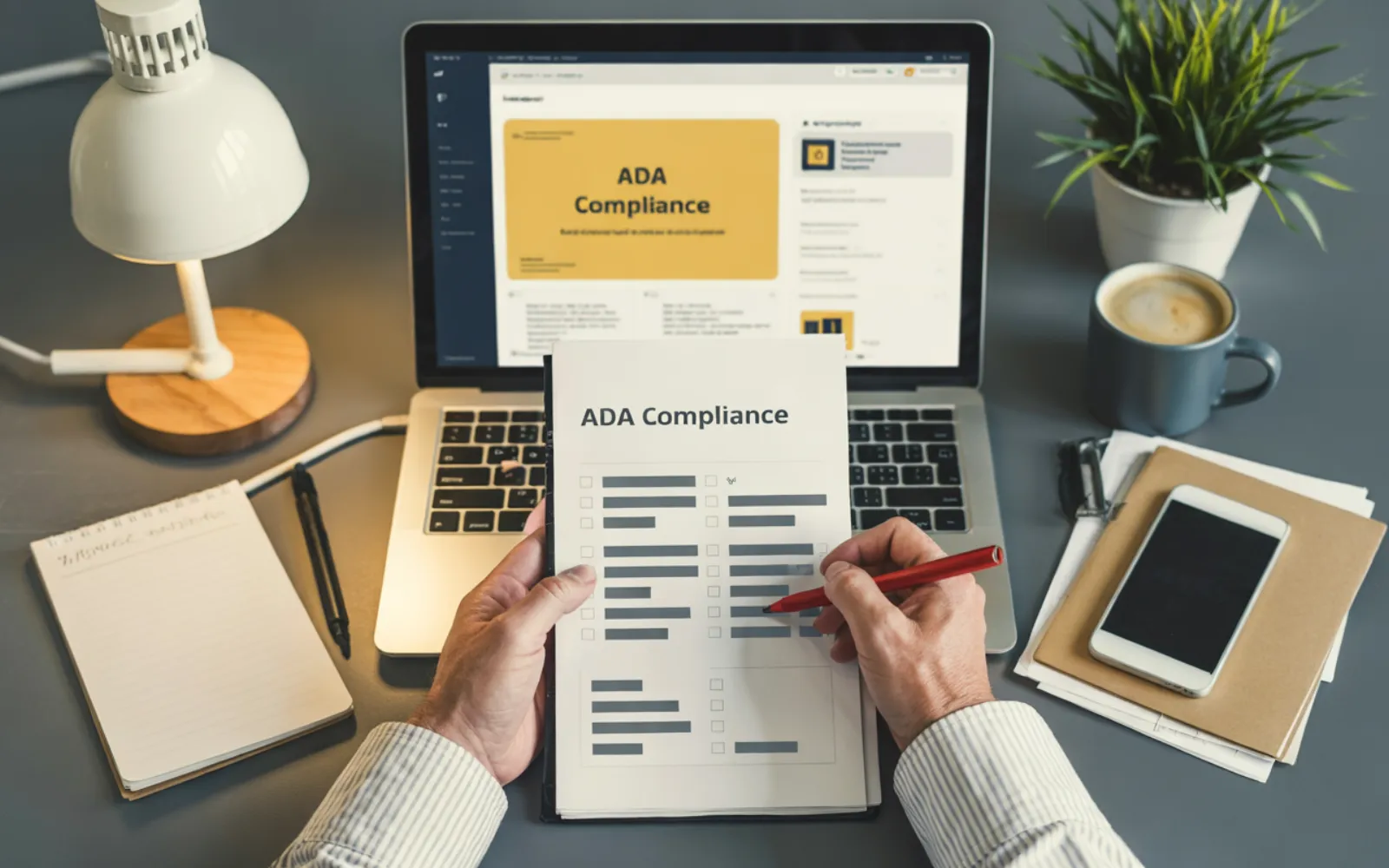
The Americans with Disabilities Act (ADA) requires businesses open to the public to make sure their websites are accessible to people with disabilities. While the ADA was written before the modern internet existed, courts and the Department of Justice have interpreted it to apply to digital content on many occasions.
In practice, "ADA compliant" websites are those that meet widely accepted accessibility standards like Web Content Accessibility Guidelines (WCAG) 2.1 Level AA.
The Department of Justice made this explicit in March 2022, noting that an inaccessible website can exclude people just as much as an unusable physical location. This guidance put all businesses on notice that web accessibility isn't optional.
For marketing teams, this means every asset you create—from your main website to landing pages, forms, videos, PDFs, and email campaigns—needs to be accessible to all users, including those with:
- Visual impairments (blindness, low vision, color blindness)
- Hearing impairments
- Motor disabilities
- Cognitive and learning disabilities
Why Web Accessibility Matters?
The Department of Justice clearly states that "inaccessible web content means people with disabilities are denied equal access to information". This isn't just a legal issue—it's a fundamental matter of inclusion.
From a practical standpoint, 71% of users with disabilities will leave a website that is difficult to use. That's a lot of potential customers turning away before they even see what you offer.
And it's not just users with disabilities who benefit from accessible design. Research shows that for 75% of consumers, ease of use is more important than price when shopping online. Accessibility improvements make your website more usable for everyone.
Think about it this way: accessibility features like clear navigation, properly labeled forms, and well-structured content help all users, regardless of ability. When we make our marketing assets accessible, we're actually delivering a better experience across the board.
The Importance of Digital Accessibility for Businesses
Beyond moral, there are compelling business reasons to take care of digital accessibility:
- Market opportunity: U.S. working-age adults with disabilities wield approximately $490 billion in disposable income. That's a massive customer base you might be missing out on.
- Customer loyalty: 83% of people with disabilities limit their online shopping to websites they know are accessible. When you invest in accessibility, you gain loyal customers who appreciate being included.
- Competitive advantage: According to a 2023-24 industry report, 72% of organizations have a formal digital accessibility policy and 85% perceive accessibility as a competitive advantage. If your competitors are making their marketing accessible and you're not, you're at a disadvantage.
For marketing teams, accessible design also brings practical benefits like improved SEO (because many accessibility best practices align with search engine preferences), better user engagement metrics, and content that works across more devices and platforms.
How to Make Your Website ADA Compliant?

On average, about 50 distinct accessibility errors occur per homepage according to an analysis of one million websites. That may sound overwhelming, but there's a clear roadmap:
- Follow the Web Content Accessibility Guidelines (WCAG) as your roadmap. WCAG 2.1 Level AA includes over success criteria across various requirements, such as:
- Providing alt text for images
- Enabling keyboard navigation
- Adding captions to videos
- Set sufficient color contrast
- Use both automated tools and manual testing. Automated checkers are helpful but only detect an estimated 30% of accessibility errors. Human judgment is needed for the rest.
- Build accessibility into your marketing processes. Train your team on basic principles, set standards for new content, and make accessibility a checkpoint in your approval workflow.
For marketing departments, this means reviewing not just your website, but all digital assets like email templates, PDFs, social media graphics, and landing pages. When creating new campaigns, accessibility should be part of the planning stage, not an afterthought.
What Happens if Your Website Isn't ADA Compliant?

The consequences of non-compliance can include:
- Legal action: On average, 12+ web accessibility lawsuits are filed each day in the U.S. (4,600+ in 2023), and even more companies receive demand letters privately.
- Financial penalties: Companies found in violation of ADA can face civil penalties up to $75,000 for a first offense (in DOJ enforcement cases), and higher for additional offenses.
- Settlement costs: Even if a lawsuit doesn't go to trial, settling an ADA web case typically costs $5,000-$20,000 (plus the cost of implementing fixes).
- Reputation damage: Being publicly called out for an inaccessible site can hurt your brand and cast the business as unfriendly to people with disabilities.
- Excluded customers: If your marketing materials aren't accessible, you're turning away millions of potential customers. 71% of users with disabilities will leave an inaccessible site without doing business.
Potential Lawsuits and Legal Consequences
The world of legal implications for ADA web compliance is increasingly active:
- E-commerce is the #1 target—roughly 82% of all web accessibility lawsuits in recent years have been against online retailers.
- Small and mid-sized businesses get hit the most—73% of accessibility lawsuits target companies under $25M in revenue.
- Repeat lawsuits are common—the number of companies facing multiple ADA web lawsuits jumped 143% in one year (2022). Settling once doesn't grant immunity.
- Major retailers aren't immune—81% of the top 500 e-commerce companies have been sued at least once over website accessibility, and 13% of them were sued in 2023 alone.
- Legal outcomes can be demanding: Many cases settle out of court, but if it goes to trial, courts can order businesses to fully conform to WCAG (as in the Winn-Dixie case), often with monitoring and reporting requirements.
All and all, every campaign, landing page, and piece of content should be viewed through an accessibility lens. The cost of retrofitting or defending against a lawsuit far exceeds the cost of building accessibility from the start.
What are the Key ADA Requirements for Websites?
While the ADA itself doesn't specify technical standards for websites, court cases and DOJ guidance have established several key requirements:
- Provide text alternatives for non-text content. Every image should have descriptive alt text—a critical requirement since missing alt text is one of the most common web accessibility failures, found on 54.5% of homepages.
- Make sure content is navigable via keyboard only. Many users cannot use a mouse; ADA compliance means all interactive elements must be accessible with keyboard tab/enter keys. In one study, 64% of e-commerce sites had issues with keyboard navigation.
- Provide captions and transcripts for multimedia. Deaf or hard-of-hearing users need access to audio information. In a landmark case, Netflix agreed to caption 100% of its streaming content as part of an ADA settlement.
- Maintain sufficient color contrast for text and backgrounds. Low-contrast text is a barrier for many with low vision or color blindness—and 81% of homepage scans in 2024 flagged low-contrast text issues.
- Use clear, descriptive link text. Avoid generic phrases like "click here" or "learn more" without context.
- Check that forms are properly labeled and include clear error messages.
For marketing teams, these requirements apply to all digital content—not just websites but also emails, social media posts, digital ads, and downloadable materials.
Steps for Website Compliance

Here's a practical process for marketing teams to follow:
- Conduct regular accessibility audits. Run automated scans for obvious errors and schedule in-depth manual reviews. This is especially important for smaller organizations—73% of accessibility lawsuits target companies under $25 million in revenue, often those that only addressed accessibility after being sued.
- Incorporate accessibility from the start of projects. It's much easier and cheaper to build accessibility into new marketing materials than to retrofit later. Addressing issues during development can be 10-100 times less costly than fixing them post-launch.
- Train your team and assign responsibility. As of 2023, 60% of companies have executive-level commitments to accessibility, and many are hiring accessibility specialists. Consider designating an accessibility champion within your marketing team.
- Develop clear guidelines for content creators. Create a style guide that includes accessibility requirements for different types of content, from blog posts to social media graphics.
By taking these proactive steps, you'll not only reduce legal compliance risk but also create marketing assets that reach a wider audience more effectively.
Regular Updates and Maintenance for Compliance

Accessibility is an ongoing effort, not a one-time project. Websites change frequently (new content, redesigns, third-party updates), so accessibility can regress if not continually maintained.
To maintain compliance:
- Schedule periodic re-evaluations: Run automated scans monthly and do a full manual audit annually. Many companies integrate accessibility checks into each software release cycle.
- Keep up with guideline updates: The web standards change—e.g., WCAG 2.2 came out in 2023 and WCAG 3.0 is in development. Regular maintenance includes staying current with these updates and adjusting your site if new recommendations emerge.
- Monitor new content: Make sure that as you add articles, product pages, PDFs, etc., they are checked for accessibility. Some organizations use content management systems with built-in accessibility check plugins—consider that for maintenance.
- Train and refresh staff knowledge: Employee turnover or new content creators may not be aware of accessibility practices. Include periodic training or refresher workshops as part of maintenance.
- User feedback loop: Revisit your accessibility feedback channel. If users report issues, address them promptly and update your checklist or practices accordingly.
- Document everything: As part of maintenance, keep records of audits, issues fixed, and improvements made. This not only helps track progress but can serve as evidence of your good-faith efforts if a compliance question arises.
For marketing teams, these maintenance practices should be integrated into your content calendar and workflow, making sure that accessibility remains a priority as your digital presence evolves.
Final Thoughts: Why Accessibility Matters for Your Marketing Success?
Making your marketing materials ADA compliant isn't just about checking boxes or avoiding lawsuits—it's about reaching more customers with your message and creating better experiences for everyone.
Investing in accessibility can yield a 9,900% ROI (a $100 return for every $1 spent) according to Forrester Research. But beyond the financial benefits, an accessible web is about equal opportunity: it means every visitor—whether they are blind, deaf, using assistive tech, or just a different device—can engage with your content.
The trend is clear: governments are enacting stricter rules (with the EU's enforcement in 2025 and the DOJ's recent actions in the U.S.), and the digital accessibility movement is gaining momentum. By acting now and following the steps outlined in this guide, you position your organization as a forward-thinking, socially responsible leader.
For marketing teams, the challenge of ensuring accessibility across all digital assets might not seem like the most exciting task. That's where tools like Luthor can help. As an AI-based solution, Luthor allows you to automatically review your marketing assets for compliance issues, reducing the risk, effort, and time required to tackle marketing compliance at scale.
Instead of manually checking each piece of content or worrying about missing critical accessibility requirements, you can use Luthor to identify potential issues before they become problems. Ready to make your marketing more accessible while reducing compliance risks? Request demo access to Luthor today and see how we can help your team create inclusive, compliant, and effective marketing materials that work for everyone.
Keep reading
Related resources

Glossary
Unlocking AI innovation with quality hill climbing
Security and compliance are now business-critical priorities. Nearly 65% of organizations say their customers
2 min

Glossary
RIA vs. Financial Advisor: Key Differences and Industry Insights
Here are the key differences between RIA vs. financial advisor and other financial professionals.
18 min

Glossary
SEC Rule 17a-4: Recordkeeping Compliance for Broker-Dealers
SEC Rule 17a-4 compliance guide for broker-dealers: implications, and recordkeeping requirements.
6 min



Never publish risk again.
Our policy and legal engineers will walk through your content workflows and regulatory obligations, then integrate Luthor in days, not months.